Verbs · Generated inflection
Complete Verb Charts
Choose a root to generate its available finite lakāras and non-finite kṛdanta forms from an indexed dhātupāṭha entry.
Your growing reference
Learn Sanskrit through Devanagari, pronunciation, sandhi, grammar and guided reading. Choose a subject, then open its Overview tab for a simple explanation before exploring the detailed lessons.

Terms · Meanings · Examples
Search Sanskrit, Devanāgarī or English, with or without diacritics. Each entry gives a definition, an illustration and links to the relevant lesson or exact source section. “Back to Glossary” keeps your search and reading position.
Devanagari · Module 01
Vowels and consonants arranged by sound. Select any row or column heading in the consonant table to trace its cross-reference.
Independent forms
Each vowel can stand independently or appear as a sign attached to a consonant.
Phonetic arrangement
Select several row and column headings at once; select a heading again to remove it.
Rows show place of articulation. Columns show voicing, aspiration and nasality.
The selected row and column are shaded; their intersection receives the strongest colour.
Marks and dividers
These signs modify a sound, show a printed elision, or divide a text. The examples place combining signs on ka so that their position is visible.
| Form | Name | IAST value | What it marks |
|---|---|---|---|
| क् | विरामvirāma · halant | no following vowel | Suppresses a consonant’s inherent a; it can leave a bare final consonant or help form a written conjunct. |
| कं | अनुस्वारanusvāra | ṃ | Marks a nasal whose phonetic realization and grammatical replacement can depend on the following sound and textual convention. |
| कँ | चन्द्रबिन्दुcandrabindu | nasalized vowel | Marks vowel nasalization. Its printed height and shape can vary with the surrounding character and font. |
| कः | विसर्गvisarga | ḥ | Marks a post-vocalic voiceless breath whose surface form is especially sensitive to the following sound under visarga sandhi. |
| ऽ | अवग्रहavagraha | ’ | In printed Sanskrit, most commonly records the loss of initial a after final e or o; it is not a general apostrophe. |
| । | दण्डdaṇḍa | text divider | Divides a prose unit or a verse half according to the editorial and textual convention in use. |
| ॥ | द्विदण्डdouble daṇḍa | major text divider | Commonly closes a verse or a larger numbered unit; exact punctuation practice varies by edition and genre. |
Descriptions are original project teaching prose checked against Whitney §§5, 9–16a and 70–73a; they are not Whitney’s wording.
Conjunct Tool 01
Use exact IAST, plain Latin letters, or type directly in Devanagari.
On-screen Sanskrit keyboard
Tap characters, then press Search.Latin / IAST vowels
Other IAST special characters
Devanagari vowels
Devanagari consonants
Enter a conjunct above and press Search. Plain letters return every matching diacritic possibility.
Search results
Conjunct Tool 02
First consonant down the side, second consonant across the top. The complete table fits the page and uses the page's normal scroll.
Click a row or column heading to highlight it; click again to turn it off. The intersection has its own colour. Select a cell to open it in Conjunct Search.
A visible virāma (्) is correct where the font has no joined ligature for that consonant pair.
Recognising joined shapes
A conjunct joins consonants with no vowel between them. The virāma (्) removes a consonant’s inherent a. Thus kṣ names the consonant cluster, while क्ष · kṣa includes the final inherent a. These are combinations of letters, not extra letters in the alphabet; their drawn shapes vary by font.
| Conjunct | Build it from | What happens to the letters |
|---|---|---|
| क्षkṣa | क् + ष → क्षk + ṣa → kṣa | क and ष form a distinctive ligature. There is no vowel between k and ṣ. |
| ज्ञjña | ज् + ञ → ज्ञj + ña → jña | The joined shape can hide its components: ज followed by ञ, not an independent letter. |
| श्रśra | श् + र → श्रś + ra → śra | श joins the following र in a distinctive shape. It contains ś, not s or ṣ. |
| त्रtra | त् + र → त्रt + ra → tra | त joins र. The cluster is dental t + r, not the aspirated consonant th. |
| क्रkra | क् + र → क्रk + ra → kra | Following r commonly appears as a lower or attached stroke (rakāra). Read k first, then r. |
| र्कrka | र् + क → र्कr + ka → rka | Initial r is drawn above as repha. Although the mark is above क, r is read before k. |
| द्धddha | द् + ध → द्धd + dha → ddha | द joins ध. The second consonant is the single aspirated consonant dh. |
| ह्मhma | ह् + म → ह्मh + ma → hma | ह joins म in a compact shape which can extend below the usual writing line. |
| ह्यhya | ह् + य → ह्यh + ya → hya | The first consonant is h; the following y is part of the same cluster. |
| क्ष्यkṣya | क् + ष् + य → क्ष्यk + ṣ + ya → kṣya | A conjunct can join another consonant: क्ष् + य. Both k and ṣ lack an intervening vowel. |
| स्त्रstra | स् + त् + र → स्त्रs + t + ra → stra | स् joins the existing त्र shape. Read all three consonants in order: s, t, r. |
| र्ज्ञrjña | र् + ज् + ञ → र्ज्ञr + j + ña → rjña | Repha can sit above a whole conjunct. The initial r is followed by the ज्ञ cluster. |
Formation reference: Unicode · Devanāgarī shaping (repha, ligature rules and sample ligatures). The rows illustrate script formation, not dictionary words.
Devanagari · Module 04
Transliterate a Sanskrit word in either direction. IAST diacritics give the most precise result.
Try an example:
Plain Latin uses common spellings: aa = ā, sh = ś, and ri = ṛ. Use diacritics when you need to distinguish sounds such as t/ṭ, d/ḍ, n/ṇ, or s/ś/ṣ.Devanagari · Module 05
Connect script, IAST, IPA and articulation. Generated audio uses a Sanskrit-specific backend when one is connected.
Classical mode presents the conservative phonemic system used in Sanskrit teaching. It does not apply modern Hindi schwa deletion.
Select a sound
Tap a character to see its IPA value and how it is articulated.
Checking the curated audio pack and pronunciation backend…
Licensed recordings play first and work offline. New or arbitrary text uses the connected Sanskrit synthesizer.Short vowels normally count as one mora; long vowels and diphthongs count as two. A short vowel before a consonant cluster (including a semivowel) makes a heavy syllable, though the vowel itself remains short.
The pulses demonstrate metrical weight only; they are not speech.Devanāgarī · Overview
Devanāgarī is a writing system used for Sanskrit. Learn to recognize the sounds represented by a written group before trying to identify the word or translate it. The alphabet, conjunct finder and pronunciation chart show different parts of that same task.
The character tables arrange letters by sound rather than by the English alphabet. Vowels can be pronounced without a consonant; consonants describe an obstruction or narrowing in the mouth. The pronunciation chart connects a written character with its transliteration and place or manner of articulation. Work through a small group at a time so that similar-looking letters do not become interchangeable.
अ कa ka
Read the vowel a and the consonant letter ka. These letter names do not have a sentence translation.
Compare the independent vowel अ with the consonant letter क. The first represents a by itself; the second is read ka because the consonant includes an inherent a. These are alphabet examples, not separate translations or complete words.
The written sign represents the vowel by itself.
The consonant is k; without another sign its inherent vowel is short a.
Identify the sounds. There is no subject, verb or object in this alphabet comparison.
Independent vowel a → consonant k with its inherent a → the reading ka.
A basic consonant letter includes the inherent vowel a. An attached vowel sign changes that vowel, while virāma suppresses it. This is why counting visible letters as though each were an English consonant can give the wrong reading. First identify the consonant, then check for a vowel sign or a mark showing that no vowel follows it.
क → का / क्ka → kā / k
Read ka, then kā with a long vowel, or k with no following vowel.
Start with क, ka. The attached ा replaces its inherent short a with long ā, giving kā. The small virāma in क् removes that vowel instead, leaving k. Changing or removing the vowel changes how the written group is read.
The base consonant includes short a.
The sign ा replaces short a with long ā; it does not add a second vowel.
Virāma ् removes the inherent vowel. These are written groups, not a sentence.
Consonant k + inherent a → replace a with ā, or suppress a with virāma.
Short and long vowels are distinct sounds, not merely different degrees of emphasis. Keep their length when reading and transliterating. The vowel table shows independent letters beside the signs used with consonants. A sign may sit beside, above or below its consonant; its position on the page is part of the writing convention, not a separate instruction about word order.
इ ईi ī
Read short i and long ī as distinct vowels.
Read इ as short i and ई as long ī; the line over ī records length, not stress. Keep that distinction when moving between Devanāgarī and IAST rather than reducing both to an unmarked English i.
Read one mora: a short vowel.
Read two morae: vowel length is part of the sound.
The macron records length, not stress. This is a sound comparison without sentence roles.
Short i ↔ long ī: vowel length changes, while the basic vowel quality remains related.
The consonant table groups sounds by where they are made. Within the stop groups, the columns distinguish voicing, aspiration and nasality. Aspiration means an accompanying release of breath; it should not be discarded as an optional extra letter. Compare sounds within one row and then down one column to hear and see which feature changes.
क ख ग घ ङka kha ga gha ṅa
Read the five consonant citations ka, kha, ga, gha and ṅa.
This is the first stop row in the alphabet. The consonants are formed in the same general place at the back of the mouth. Moving across the row changes voicing, aspiration and finally nasality: kh and gh include aspiration, while ṅ is the nasal. The written a belongs to the citation of each letter.
k is unaspirated; kh adds an aspirated release. Both are voiceless.
g is voiced and unaspirated; gh is voiced and aspirated.
ṅ is the velar nasal. The citation vowel a is separate from these consonant features.
Same place of articulation → changes in voicing and aspiration → nasal member at the end of the row.
A conjunct represents a consonant sequence. Its written shape may combine familiar parts or use a less obvious ligature, so the complete shape is not always easy to guess from the separate letters. Use the finder to identify the component consonants, then read the vowel belonging to the group. Joining letters in writing does not by itself explain the word’s grammar.
क्षkṣa
Read kṣa: k and ṣ together, followed by a.
The conjunct क्ष combines k and ṣ with no vowel between them. There is still a vowel after the consonant group: without another vowel sign, the group is read kṣa. Do not read it as kaṣa or assume the single combined shape represents one simple consonant.
The first member has no vowel after it.
The second consonant is ṣ; the group ends in the inherent a.
Read one consonant cluster. This isolated spelling example has no subject or object.
k + ṣ, with no intervening vowel → kṣ; add the group's inherent a → kṣa.
Anusvāra and candrabindu mark nasal features; visarga marks a breath after a vowel. Their interpretation depends on sound and context. Avagraha commonly records a lost initial a in the printed result of sandhi. The single and double daṇḍa divide text according to the edition’s convention. These marks are useful clues, but none replaces identifying the underlying words.
ते + अब्रुवन् → तेऽब्रुवन्te + abruvan → te ’bruvan
They spoke.
The apostrophe-like avagraha ऽ marks the initial a lost after final e in this sandhi example. It does not stand for a newly pronounced sound. Restoring abruvan explains what the small mark is recording; it is not a reason to remove other vowels.
‘They’: masculine nominative plural of the demonstrative pronoun.
‘Spoke’: third-person plural imperfect of √brū; its initial a is not pronounced after te here.
Avagraha marks that elided a. No direct object is supplied in this short example.
Subject te → finite verb abruvan; final e + initial a → e with the initial a elided and marked by avagraha.
Transliteration represents the same Sanskrit sounds in another script; it does not translate them into English. Keep the diacritics because they distinguish sounds and vowel lengths. Compare a short passage in both scripts, checking each consonant group and vowel. The converter helps with this comparison, while the Conjunct Finder helps you identify an unfamiliar consonant group.
क्षkṣa
The Devanāgarī group and its IAST spelling both represent kṣa; neither alone supplies a word meaning.
क्ष and kṣa represent the same sounds in Devanāgarī and IAST. Transliteration preserves k, ṣ and the final a; it does not supply an English meaning. The dot in ṣ distinguishes it from plain s, so use the complete IAST spelling when checking the conversion.
A combined shape represents the consonant cluster and its following vowel.
k, ṣ and a are preserved in order; the dot in ṣ distinguishes it from s.
The script changes; the sounds do not. There are no sentence roles in this isolated group.
Consonants k + ṣ + vowel a ↔ the same sounds written in another script.

Internal Sandhi · Vowels
Use these charts where a root, stem, suffix or compound member meets the next element. They show the sound boundary, not a claim about how an unfamiliar word must be segmented.
Open a cell: select any table body cell to see its exact rule application. Complete-grid cells are labelled as rule illustrations rather than lexical attestations; rows that supply a worked word identify it separately. Highlight a path: select a main row or column heading to highlight that whole axis; select it again to clear the highlight. Guṇa and vṛddhi: in these sandhi tables, the names identify vowel combinations such as a/ā + i/ī → e (guṇa) and a/ā + e/ai → ai (vṛddhi). On morphology pages, the same terms name the full and lengthened grades of a root or stem.Click a cell for its exact result
Traditional rule names
Select a named type to illuminate every matching result in the complete charts.
सवर्णदीर्घ · गुण · वृद्धि · यण्savarṇa-dīrgha · guṇa · vṛddhi · yaṇ
Use this within a word—for example, where a root meets a suffix or two members of a compound meet.
| a | ā | i | ī | u | ū | ṛ | ṝ | ḷ | e | ai | o | au | |
|---|---|---|---|---|---|---|---|---|---|---|---|---|---|
| a / ā | ā | ā | e | e | o | o | ar | ar | al† | ai | ai | au | au |
| i / ī | ya | yā | ī | ī | yu | yū | yṛ | yṝ | yḷ | ye | yai | yo | yau |
| u / ū | va | vā | vi | vī | ū | ū | vṛ | vṝ | vḷ | ve | vai | vo | vau |
| ṛ / ṝ | ra | rā | ri | rī | ru | rū | ṝ† | ṝ† | rḷ | re | rai | ro | rau |
| ḷ | la | lā | li | lī | lu | lū | lṛ | lṝ | ḹ† | le | lai | lo | lau |
† Whitney §§126–127 marks ṛ/ṝ coalescence as questionable in practice and a/ā + ḷ → al as theoretical; long vocalic l (ḹ) is likewise theoretical. These cells show formal rules, not attested words. In a few internal morphological environments, ī/ū + vowel may appear as iy/uv instead of y/v.
अयादिayādi
Internally, e, ai, o and au recover their glide element before another vowel.
| a | ā | i | ī | u | ū | ṛ | ṝ | ḷ | e | ai | o | au | |
|---|---|---|---|---|---|---|---|---|---|---|---|---|---|
| e | aya | ayā | ayi | ayī | ayu | ayū | ayṛ | ayṝ | ayḷ | aye | ayai | ayo | ayau |
| ai | āya | āyā | āyi | āyī | āyu | āyū | āyṛ | āyṝ | āyḷ | āye | āyai | āyo | āyau |
| o | ava | avā | avi | avī | avu | avū | avṛ | avṝ | avḷ | ave | avai | avo | avau |
| au | āva | āvā | āvi | āvī | āvu | āvū | āvṛ | āvṝ | āvḷ | āve | āvai | āvo | āvau |
सवर्णदीर्घसन्धि · Savarṇa-dīrgha
Pāṇini 6.1.101 · अकः सवर्णे दीर्घः · akaḥ savarṇe dīrghaḥ
Two vowels of the same quality merge into the corresponding long vowel.
| Combination | Result |
|---|---|
| a/ā + a/ā | ā |
| i/ī + i/ī | ī |
| u/ū + u/ū | ū |
| ṛ/ṝ + ṛ/ṝ | ṝ† |
| ḷ + ḷ | ḹ† |
गुणसन्धि · Guṇa
Pāṇini 6.1.87 · आद् गुणः · ād guṇaḥ
The two boundary vowels are replaced by the corresponding guṇa result.
| Combination | Result |
|---|---|
| a/ā + i/ī | e |
| a/ā + u/ū | o |
| a/ā + ṛ/ṝ | ar |
| a/ā + ḷ | al† |
A preverb ending in a/ā before a root beginning in short ṛ may exceptionally give ār.
वृद्धिसन्धि · Vṛddhi
Pāṇini 6.1.88 · वृद्धिर् एचि · vṛddhir eci
The two boundary vowels are replaced by the corresponding vṛddhi result.
| Combination | Result |
|---|---|
| a/ā + e/ai | ai |
| a/ā + o/au | au |
यण्सन्धि · Yaṇ
Pāṇini 6.1.77 · इको यण् अचि · iko yaṇ aci
The first vowel becomes its corresponding glide.
| First vowel + V | Result | Example |
|---|---|---|
| i/ī + V | y + V | i + a → ya |
| u/ū + V | v + V | u + a → va |
| ṛ/ṝ + V | r + V | ṛ + a → ra |
| ḷ + V | l + V | ḷ + a → la |
अयादिसन्धि · Ayādi
Pāṇini 6.1.78 · एचोऽयवायावः · eco ’yavāyāvaḥ
The first vowel opens into an ay-, āy-, av- or āv- sequence before the next vowel.
| First vowel + V | Result | Example before a |
|---|---|---|
| e + V | ay + V | e + a → aya |
| ai + V | āy + V | ai + a → āya |
| o + V | av + V | o + a → ava |
| au + V | āv + V | au + a → āva |
Internal Sandhi · Consonants
Internal consonant changes depend on the exact root, stem, suffix and intervening sounds. Begin with the local boundary, then test the wider word for triggers and blockers.
Every documented family is represented below. Select any body cell to open its Sanskrit example, explanation, and Whitney section. These are rule families rather than an arbitrary consonant-by-consonant matrix: the outcome can depend on a root's lexical class, aspiration history, or sounds earlier in the word.Click a cell for an example
Traditional rule names
Select a process to highlight its rows across the detailed tables.
Use the first column to decide which detailed table to inspect. Select any cell in a row for a representative example.
| Check | Possible process | Detailed table |
|---|---|---|
| Aspirated or voiced stop at the boundary | Deaspiration, voicing agreement, aspiration transfer | Aspiration & voicing |
| Earlier i, u, ṛ, k, r or ṣ | ṣatva or ṇatva, subject to blockers | Retroflexion |
| Dental beside palatal or retroflex | Palatal or retroflex assimilation | Dental contact |
| Root ends in c, ch, j, ś, ṣ, kṣ or h | Lexically conditioned root-final replacement | Root-final changes |
| Nasal at the boundary | Homorganic nasal, anusvāra, n, or loss | Nasals |
| Three-consonant cluster or doubled consonant | Extension, abbreviation, or spelling variation | Clusters & spelling |
Coverage follows Whitney’s ordered inventory in §§114–124 and its detailed rules through §233. Vedic-only phonetic phenomena are identified rather than presented as ordinary Classical spelling rules.
Root + ending: √budh + ta → buddha is worked through in Bartholomae’s law. For palatal contact, see √yaj + na → yajña and the blocker in ścutva.
Stops agree in voicing, while aspiration can be lost, transferred, or restored from the root's history.
| Environment | Result | Example |
|---|---|---|
| dh + t/th | ddh | budh + ta → buddha |
| bh + t/th | bdh | labh + ta → labdha |
| h < gh + t/th | gdh | duh + ta → dugdha |
| Voiced stop + voiceless stop | First stop becomes voiceless | ad + ti → atti |
| Voiceless stop + voiced stop | First stop becomes voiced | śak + dhi → śagdhi |
| Present stem dadh- before thas | Initial aspiration restored | dadh + thas → dhatthas |
These rules inspect more than the adjacent pair. Always test intervening blockers and lexical exceptions.
| Family | Core condition | Example |
|---|---|---|
| ṣatva | s → ṣ after i/u/ṛ/k in the same word | havis + ā → haviṣā |
| Suffixal ṣatva | Suffix-initial s becomes ṣ | bhavi + syāmi → bhaviṣyāmi |
| ṣatva blocker | Following r prevents s → ṣ | usra, not *uṣra |
| ṇatva | n → ṇ after r/ṛ/ṣ in the same word | rāma + ena → rāmeṇa |
| Prefixal ṇatva | Prefix r licenses later n → ṇ | pari + nīyate → pariṇīyate |
| ṇatva blocker | Immediate guttural/labial can prevent n → ṇ | kṣubhnāti |
A dental takes the place of articulation of a neighbouring palatal (ścutva) or retroflex (ṣṭutva) in the specified internal environments.
| Contact | Result | Example |
|---|---|---|
| Palatal + n | n → ñ | yaj + na → yajña |
| j + n | jñ | rāj + nī → rājñī |
| Retroflex + dental | Dental becomes retroflex | ṣaṣ + nām → ṣaṇṇām |
| Dental stop + dental stop | Homogeneous dental cluster | ad + ta → atta |
The following sound determines whether a final nasal becomes homorganic, anusvāra, n, or is lost in a lexical formation.
| Environment | Result | Example |
|---|---|---|
| Lexically specified m + suffix | m may disappear | gam + ta → gata |
| m + spirant | ṃ + spirant | sam + skṛta → saṃskṛta |
| m + v | nv | gam + vahi → ganvahi |
| n + sibilant | ṃ + sibilant | man + syate → maṃsyate |
| Nasal before a stop | Homorganic nasal at the stop's place | sam + kalpa → saṅkalpa |
These outcomes are class-sensitive. The same written final can belong to more than one historical root class.
| Root final / class | Before suffix | Example |
|---|---|---|
| c | c → k | vac + ti → vakti |
| c + s | kṣ | vac + syāmi → vakṣyāmi |
| ś + t/th | ṣṭ/ṣṭh | diś + ta → diṣṭa |
| j, yuj class | j → k | yuj + ta → yukta |
| j, mṛj class | j → ṣ before t | mṛj + ta → mṛṣṭa |
| ch in prach | ch → ś before n | prach + na → praśna |
| ṣ + t/th | ṣṭ/ṣṭh | dviṣ + ta → dviṣṭa |
| h, duh class | gdh / kṣ by environment | duh + ta → dugdha |
| h, ruh class | ḍh with vowel lengthening | ruh + ta → rūḍha |
These rows distinguish productive phonology from optional, historical, Vedic, or manuscript conventions.
| Phenomenon | Status | Example |
|---|---|---|
| ch extension | ch may be written cch after a vowel | pra + chad → pracchad |
| Doubling after r | Optional / editorial | arka / arkka |
| Cluster abbreviation | First stop of a heavy cluster may drop | yuṅgdhi → yuṅdhi |
| Doubled-stop simplification | Manuscript variation | dattvā / datvā |
| Vedic phonetic insertions | Advanced; not standard Classical spelling | yama, nāsikya, svarabhakti |
Bartholomae’s law · often nicknamed “Buddha sandhi”
This source-verified Sanskrit environment is internal and morphological: a root ending in the voiced aspirate gh, dh or bh is followed by t or th at the start of an ending. It is not a blanket rule for any aspirated stop before any voiceless consonant.
| Formation | After 8.2.40 | After 8.4.53 | English |
|---|---|---|---|
| √budh + ta | budh + dha | buddha | awakened; understood |
| √labh + ta | labh + dha | labdha | obtained; gained |
| √labh + tvā | labh + dhvā | labdhvā | having obtained |
श्चुत्व · ścutva · source-checked contact rule
Pāṇini 8.4.40 covers s and the dental tu class in contact with ś or a member of the palatal cu class. The dental-side sound is replaced by ś or the corresponding palatal. The palatal trigger may stand before or after it; Whitney §118c independently summarizes the contiguous-palatal change.
| Source formation | Contact test | Outcome | Supported meaning |
|---|---|---|---|
| √yaj + na | j + n → j + ñPalatal j precedes dental n; 8.4.40 changes n to corresponding palatal ñ. | yajña | sacrificeExact Vasu example; meaning checked at MW L=169220–169221. |
| praś + na | ś + n ↛ ś + ñPāṇini 8.4.44 blocks the dental-to-palatal change when ś precedes. | praśna | questionExact Vasu 8.4.44 result; meaning checked at MW L=137599. |
External Sandhi · Vowels
Compare the final vowel of the first word with the initial vowel of the next, then follow that row and column through the complete adopted lookup grid.
Open a cell: select a table body cell to see its exact rule or chart result. Where the table supplies a worked word, the dialog identifies it as a worked example; complete lookup-chart formulas are labelled as chart results, not lexical attestations. Highlight a path: select a main row or column heading to highlight that whole axis; select it again to clear the highlight. A space in the chart marks retained hiatus at a word boundary.Click a cell for its exact result
Traditional rule names
Select a type to highlight every matching cell in the adopted lookup chart.
Source-based reference chart
Use the final sound across the top and the following initial sound at the right. Select a row and column to trace one boundary through the chart.
सवर्णदीर्घ · गुण · वृद्धि · यण् · पूर्वरूप · अयादिsavarṇa-dīrgha · guṇa · vṛddhi · yaṇ · pūrvarūpa · ayādi
A space indicates a word break.
’ marks the loss of a following initial a at the word boundary; Devanāgarī shows this with avagraha ऽ.
| Final vowels | Initial | |||||||
|---|---|---|---|---|---|---|---|---|
| -a/-ā | -i/-ī | -u/-ū | -ṛ | -e | -ai | -o | -au | |
| -ā- | -ya- | -va- | -ra- | -e ’- | -ā a- | -o ’- | -āva- | a- |
| -ā- | -yā- | -vā- | -rā- | -a ā- | -ā ā- | -a ā- | -āvā- | ā- |
| -e- | -ī- | -vi- | -ri- | -a i- | -ā i- | -a i- | -āvi- | i- |
| -e- | -ī- | -vī- | -rī- | -a ī- | -ā ī- | -a ī- | -āvī- | ī- |
| -o- | -yu- | -ū- | -ru- | -a u- | -ā u- | -a u- | -āvu- | u- |
| -o- | -yū- | -ū- | -rū- | -a ū- | -ā ū- | -a ū- | -āvū- | ū- |
| -ar- | -yṛ- | -vṛ- | -ṝ- | -a ṛ- | -ā ṛ- | -a ṛ- | -āvṛ- | ṛ- |
| -ai- | -ye- | -ve- | -re- | -a e- | -ā e- | -a e- | -āve- | e- |
| -ai- | -yai- | -vai- | -rai- | -a ai- | -ā ai- | -a ai- | -āvai- | ai- |
| -au- | -yo- | -vo- | -ro- | -a o- | -ā o- | -a o- | -āvo- | o- |
| -au- | -yau- | -vau- | -rau- | -a au- | -ā au- | -a au- | -āvau- | au- |
External Sandhi · Consonants
Start with the final sound of the first word, then identify the initial sound that follows. Work through stops, visarga and final m before consulting the complete source grid.
Open a cell: select a table body cell to see its exact rule or chart result. Worked-example rows remain labelled as examples; complete lookup-chart formulas are labelled as chart results, not lexical attestations. Highlight a path: select a main row or column heading to highlight that whole axis; select it again to clear the highlight. A final stop normally follows the next sound’s voicing and may also change place; final s/r appears as visarga in pause and changes again before another sound.Click a cell for its exact result
Traditional rule names
Select a type to illuminate its cells in the worked tables and complete source chart.
Match voicing, then assimilate strongly before a stop, nasal or l.
Choose the rule from the preceding vowel and the following sound.
Final m becomes anusvāra before a consonant; internal nasals match the next stop.
Dental sounds become palatal or retroflex beside matching sounds.
C represents any stop. The most useful first question is whether the following sound is voiced or voiceless.
| Final sound | Following sound | Result | Worked example |
|---|---|---|---|
| voiceless stop | voiced sound | corresponding voiced stop | tat + bhavati→ tad bhavatiतत् + भवति → तद् भवति |
| voiced stop | voiceless sound | corresponding voiceless stop | sad + kṛ→ satkṛसद् + कृ → सत्कृ |
| t / d | c / ch | c | tat + ca→ taccaतत् + च → तच्च |
| t / d | j / jh | j | sat + jana→ sajjanaसत् + जन → सज्जन |
| t / d | l | l | tat + loka→ tallokaतत् + लोक → तल्लोक |
| t / d | n / m | matching nasal | tat + nāma→ tan nāmaतत् + नाम → तन्नाम |
| k / g | vowel or voiced sound | g | vāk + īśa→ vāgīśaवाक् + ईश → वागीश |
Final jaśtva · project learner heading
Pāṇini 8.2.39 first replaces an eligible pada-final jhal stop with the same-place member of the technical set jaś. In the external environment described by Whitney, that voiced result remains before a following vowel or other voiced sound. “Final jaśtva” is a convenient modern grammatical label used by this project; it is not presented as wording by Pāṇini, Vasu or Whitney.
| Formation | After 8.2.39 | Combined form | English |
|---|---|---|---|
| ap + ja | ab + ja | abja | water-born; a lotus |
| dik + gaja | dig + gaja | diggaja | elephant of a direction |
| ṣaṭ + aha | ṣaḍ + aha | ṣaḍaha | a period of six days |
These are the high-frequency external rules. The apostrophe-like avagraha ’ marks the loss of an initial a.
| Ending | Next sound | Result | Example |
|---|---|---|---|
| aḥ | a | o ’ | rāmaḥ + atra→ rāmo ’traरामः + अत्र → रामोऽत्र |
| aḥ | other vowel | a + vowel | rāmaḥ + iha→ rāma ihaरामः + इह → राम इह |
| aḥ | voiced consonant | o | rāmaḥ + gacchati→ rāmo gacchatiरामः + गच्छति → रामो गच्छति |
| āḥ | vowel or voiced consonant | ā | narāḥ + gacchanti→ narā gacchantiनराः + गच्छन्ति → नरा गच्छन्ति |
| aḥ / āḥ | k kh p ph | ḥ remains | rāmaḥ + paṭhati→ rāmaḥ paṭhatiरामः पठति |
| Environment | Result | Example | Devanāgarī |
|---|---|---|---|
| iḥ / īḥ + voiced sound | ir / īr | muniḥ + asti → munir asti | मुनिरस्ति |
| uḥ / ūḥ + voiced sound | ur / ūr | guruḥ + vadati → gurur vadati | गुरुर्वदति |
| ḥ + c / ch | ś | rāmaḥ + ca → rāmaś ca | रामश्च |
| ḥ + ṭ / ṭh | ṣ | dhanuḥ + ṭaṅkāraḥ → dhanuṣṭaṅkāraḥ | धनुष्टङ्कारः |
| ḥ + t / th | s | namaḥ + te → namas te | नमस्ते |
| ḥ + ś / ṣ / s | ḥ or matching sibilant | hariḥ śete → hariḥ śete / hariś śete | हरिः शेते |
| Environment | Rule | Example |
|---|---|---|
| m + vowel | m remains | phalam asti → phalam asti |
| m + consonant | m → ṃ | phalam khādati → phalaṃ khādati |
| ṃ + k/kh/g/gh | ṅ may be written | saṃ + kalpa → saṅkalpa |
| ṃ + c/ch/j/jh | ñ may be written | sam + cara → sañcara |
| ṃ + ṭ/ṭh/ḍ/ḍh | ṇ may be written | aṃ + ṭa → aṇṭa (homorganic pronunciation) |
| ṃ + t/th/d/dh | n may be written | sam + toṣa → santoṣa |
| ṃ + p/ph/b/bh | m may be written | sam + pada → sampada |
Source-based reference chart
Use the final sound across the top and the following initial sound at the right. Select a row and column to trace one boundary; the continuous chart retains all nineteen source rows.
After Coulson; a hyphen indicates a join. Taylor’s chart spans pp.62–63, with the four numbered notes printed on p.63 retained below.
Click any result cell for its selected boundary and a sound-pattern example.
| Final letter | Initial | |||||||||
|---|---|---|---|---|---|---|---|---|---|---|
| -k | -ṭ | -t | -p | -ṇ | -n | -m | -ḥ/-r | -āḥ | -aḥ | |
| -k- | -ṭ- | -t- | -p- | -ṇ- | -n- | -ṃ | -ḥ | -āḥ | -aḥ | k-/kh- |
| -g- | -ḍ- | -d- | -b- | -ṇ- | -n- | -ṃ | -r- | -ā | -o | g-/gh- |
| -k- | -ṭ- | -c- | -p- | -ṇ- | -ṃś- | -ṃ | -ś- | -āś- | -aś- | c-/ch- |
| -g- | -ḍ- | -j- | -b- | -ṇ- | -ñ- | -ṃ | -r- | -ā | -o | j-/jh- |
| -k- | -ṭ- | -ṭ- | -p- | -ṇ- | -ṃṣ- | -ṃ | -ṣ- | -āṣ- | -aṣ- | ṭ-/ṭh- |
| -g- | -ḍ- | -ḍ- | -b- | -ṇ- | -ṇ- | -ṃ | -r- | -ā | -o | ḍ-/ḍh- |
| -k- | -ṭ- | -t- | -p- | -ṇ- | -ṃs- | -ṃ | -s- | -ās- | -as- | t-/th- |
| -g- | -ḍ- | -d- | -b- | -ṇ- | -n- | -ṃ | -r- | -ā | -o | d-/dh- |
| -k- | -ṭ- | -t- | -p- | -ṇ- | -n- | -ṃ | -ḥ | -āḥ | -aḥ | p-/ph- |
| -g- | -ḍ- | -d- | -b- | -ṇ- | -n- | -ṃ | -r- | -ā | -o | b-/bh- |
| -ṅ- | -ṇ- | -n- | -m- | -ṇ- | -n- | -ṃ | -r- | -ā | -o | n-/m- |
| -g- | -ḍ- | -d- | -b- | -ṇ- | -n- | -ṃ | -r- | -ā | -o | y-/v- |
| -g- | -ḍ- | -d- | -b- | -ṇ- | -n- | -ṃ | zero1 | -ā | -o | r- |
| -g- | -ḍ- | -l- | -b- | -ṇ- | -ṃl-2 | -ṃ | -r- | -ā | -o | l- |
| -k- | -ṭ- | -c(ch)- | -p- | -ṇ- | -ñ(ś/ch)- | -ṃ | -ḥ | -āḥ | -aḥ | ś- |
| -k- | -ṭ- | -t- | -p- | -ṇ- | -n- | -ṃ | -ḥ | -āḥ | -aḥ | ṣ-/s- |
| -g(gh)- | -ḍ(ḍh)- | -d(dh)- | -b(bh)- | -ṇ- | -n- | -ṃ | -r- | -ā | -o | h- |
| -g- | -ḍ- | -d- | -b- | -ṇ/ṇṇ-3 | -n/nn-3 | -m- | -r- | -ā | -a4 | vowels |
| -k | -ṭ | -t | -p | -ṇ | -n | -m | -ḥ | -āḥ | -aḥ | zero |
Sandhi · Joining Words
Sound contact and grammatical wordhood are different questions. First decide whether the pieces make one inflected word or lexical compound; only then apply the internal or external sandhi rule licensed at that boundary.
Wordhood before spelling
Use the grammatical construction to locate the boundary; use the linked sandhi chart to work out its visible form.
vi- (preverb) + a- (past augment) + gaccha- (present stem) + -n (third-plural secondary ending) are internal pieces of one imperfect form. See the preverb overview.
नराः is the subject and गच्छन्ति is the verb. External visarga sandhi changes narāḥ to narā before voiced g; it does not make a noun–verb compound. See external consonant sandhi.
Preverbs, augments, stems, suffixes and endings that belong to one inflected form are written together after internal changes: वि + अ + गच्छ + न् → व्यगच्छन्. Check internal vowel sandhi.
Members that form one compound are written as one compound word; the final inflection belongs to the whole. This differs from two independent words merely touching in a sentence. See compounds.
Subjects, objects, modifiers and verbs remain distinct grammatical words, but their boundary still takes external sandhi. In Devanāgarī, use the normal sandhied spelling; in IAST, retain an analytical space where it clarifies units such as the conjunction ca. Check external vowel and consonant sandhi.
Manuscripts and editions differ in how visibly they mark word division. A continuous written string is not proof that every element is one grammatical word. Whitney §9 describes the editorial distinction.
Worked imperfect
The noun is nominative plural: “the people.”
vi- supplies the dispersive meaning, a- is the past augment, gaccha- is the present stem, and -n is the third-plural secondary ending.
Final i of the preverb becomes y before the vowel-initial augment. The separate change √gam → gaccha- belongs to present-stem formation, not this sandhi.
The visarga is lost before voiced v, but the subject and verb remain two grammatical words.
Tools · Combine
Enter IAST or Devanāgarī. A space fixes an external word boundary. A + marks the exact boundary without forcing it to be internal; use the scope menu to test internal rules, external rules, or both.
The tool changes one boundary at a time and reports only rules represented by the adopted charts or the explicitly listed internal-contact rules.
Tools · Resolve
Enter a sandhied form in IAST or Devanāgarī. Resolution is inherently many-to-one, so the tool returns possible source pairs rather than one falsely certain answer.
Because several inputs can produce the same surface, candidates remain labelled possibilities until vocabulary and sentence context confirm one.
Sandhi · Overview
Sandhi describes changes at a sound boundary. A written Sanskrit passage can therefore look different from its separate dictionary forms. Learn what meets at the boundary, which rule applies there, and how the grammatical words can be recovered from the result.
Internal sandhi operates within a word or grammatical formation; external sandhi operates between words. Those environments cannot always be treated alike. A prefix, stem, augment or ending can create a sound contact whose grammatical role matters. Identify the pieces before selecting a table, rather than choosing a rule only because two letters happen to be next to each other.
गो + य → गव्यgo + ya → gavya
Relating to cattle; bovine.
Here go is a stem and -ya is a derivational suffix: the boundary is inside a newly formed word. Final o becomes av before this suffix, giving gavya, ‘relating to cattle’. Because the formation is internal, an external word-final o rule is not the correct explanation.
‘Cow; cattle’: the lexical base of the new adjective.
Builds a related adjective; this is not a separate word in a sentence.
Final o appears as av in this formation. The compound-like written unity is a derivation, not an external word boundary.
Noun stem go + derivational suffix -ya → internal stem adjustment o → av → gavya.
The vowel tables organize the main outcomes. Savarṇa-dīrgha combines similar simple vowels into the corresponding long vowel: a + a → ā. Guṇa sandhi includes a + i → e, while vṛddhi sandhi includes a + e → ai. Yaṇ describes glide formation, as in i + a → ya. Learn the stated environment with each name; the name alone is not a complete rule.
अति + इव → अतीवati + iva → atīva
Exceedingly; very much.
The two vowels meeting at this boundary are i and i. Savarṇa-dīrgha replaces them together with long ī, leaving the other sounds in order. By contrast, i before a different vowel may require a glide rather than simple lengthening.
An indeclinable with a sense such as ‘beyond; exceedingly’. Its final sound is i.
An indeclinable particle; its first sound is i.
Similar-vowel sandhi gives ī. The conventional combined sense is ‘exceedingly’, not a finite clause with a subject or object.
Final i of ati + initial i of iva → one long ī; the remaining sounds stay in order.
Guṇa and vṛddhi also name vowel grades used in building grammatical forms. In that setting, the question is which shape a root or stem takes in a particular construction. In vowel sandhi, the question is what happens when actual vowels meet. The resulting sounds may be related, but a root’s strong grade is not evidence that two separate words were joined.
राज + इन्द्र → राजेन्द्रrāja + indra → rājendra
Chief of kings; a king of kings.
This sandhi example contains two actual pieces whose adjacent a and i produce e. That is different from saying that a root takes a guṇa grade in a grammatical construction. First identify the two input parts; only then explain their boundary as a + i → e.
‘King’ in compound form; it narrows the domain of the head.
Here ‘chief; lord’, giving the relation ‘chief of kings’.
The two actual vowels merge by guṇa sandhi. The displayed compound stem has no sentence ending or stated sentence role.
Compound member rāja + head indra → a + i becomes e → the compound rājendra.
Consonant contacts can involve voicing, aspiration, place of articulation, nasalization or loss. Work from the final sound of the first part and the initial sound of the second. The internal and external tables show the relevant environments separately. In a table, a body cell opens its rule information; the headings and named rule controls help you compare related results.
अभूत् + अयम् → अभूदयम्abhūt + ayam → abhūd ayam
This one was; this one came to be.
The first word ends in the voiceless stop t. Before the following vowel, that stop appears as its voiced counterpart d. The words remain grammatically separate even though the Devanāgarī can be written together; the change is at their boundary.
Third-person singular aorist of √bhū, ‘was; became’. It precedes its subject here.
Masculine nominative singular, ‘this one’.
Voicing gives abhūd ayam. √bhū is intransitive here; no direct object is expressed.
Subject ayam → finite verb abhūt; t becomes voiced d before the following vowel a.
A final visarga can remain, change or disappear according to the preceding and following sounds. A written nasal can likewise reflect an adjustment at a boundary. Do not simply erase these signs while searching a dictionary: they may be part of the evidence for an inflected ending. Recover a possible word and then check whether its grammatical form fits the sentence.
नलस् + नाम → नलो नामnalas + nāma → nalo nāma
Nala by name; named Nala.
The underlying form nalas ends in -s; its isolated word-final shape has visarga. Whitney gives nalo nāma as an example of final -as becoming -o before a voiced consonant. Preserve that ending information when recovering the name: nalo is not a new dictionary stem ending in o.
A working that exposes the masculine nominative singular ending -s; the isolated word form is nalaḥ.
Here ‘by name’, qualifying the named person rather than serving as a direct object.
Final -as appears as -o before n. This is a phrase; its wider clause and finite verb are not supplied.
Underlying nominative Nala-s → surface nalo before voiced n; nāma identifies the name.
One surface sequence can arise from more than one division. A possible sound split becomes a useful reading only when its words, endings and sentence relationships also work. The Combine and Resolve tools help explore supported patterns, but they cannot establish the intended meaning on their own. Keep alternatives until the verb, agreement and context support one reading.
a/ā + a/ā → ā
Any of the four listed short/long a combinations has the long-vowel result ā in this sound pattern.
The chart groups four possible length combinations under the same long-vowel outcome. Therefore seeing ā alone cannot tell you whether the original first and second vowels were short or long. This is a sound-pattern demonstration, not an attested word: a proposed split still needs real words and workable grammar.
The first vowel may be short or long.
The second vowel may also be short or long.
The output alone does not recover the original lengths. This is a formula with no lexical meaning, subject or object.
Possible inputs a + a, a + ā, ā + a or ā + ā → the same output ā → more than one reverse split.
Some forms preserve a final vowel that a general table might appear to combine. Other changes belong only to a specified root, prefix or derivation. The exemptions lesson explains these restrictions and links them to source passages. A sound formula illustrates a pattern; it is not automatically an attested word or permission to apply that pattern in every grammatical setting.
अ + इत → ऐतa- + ita → aita
Went: a past form built with the augment.
The initial a- is grammatical material marking the past construction, not a separate word. Before root-initial i it produces vṛddhi ai here, not the ordinary guṇa e of a general a + i sandhi row.
Grammatical material attached to the verb; it is not a free-standing word or a subject.
The verbal element begins with i after the augment.
This specified augment environment gives ai, not the e of ordinary a + i guṇa sandhi. No separate object is given in the form illustration.
Past augment a- + vowel-initial verbal material ita → exceptional vṛddhi ai → aita.
Overview · Major Rule Map
Internal and external tell you where a boundary occurs. Vowel, consonant and visarga tell you what meets there. Guṇa, yaṇ, voicing, ścutva and the other family names tell you what kind of change happens.
स्वरसन्धि · svara-sandhi
व्यञ्जनसन्धि · vyañjana-sandhi
विसर्गसन्धि · visarga-sandhi
Overview · Explain
Begin with the boundary: decide whether it is inside one word or between words, then identify the meeting sounds. Each lesson explains a current teaching rule in plain English and reuses its Sanskrit example.
Internal · Vowels
Read the ordered vowels, then identify the morphemes and boundary type. The five named families below explain the regular internal patterns shown in the charts. Treat each result as an ordered operation in its stated environment, not as an unrestricted substitution for the same letters elsewhere.
Internal · Consonants
The bounded lessons teach Bartholomae’s root + ending pattern and ścutva immediate contact, including the 8.4.44 praśna blocker. Ruki/ṣatva and ṇatva now have source-linked worked orientations above; ṣṭutva remains a future topic, with no worked rule implied here.
External · Vowels
Read the final vowel of the first word across the source chart and the initial vowel of the next word down its side. Simple vowels use the same core families; the focused chart then shows what changes when the first word ends in e, ai, o or au.
External · Consonants
Check final stops first, then visarga after a/ā, other visarga environments, and finally m and homorganic nasals.
Complete adopted exception catalogue · Whitney §§136–138
Each exception in Whitney’s three-part catalogue is separated below by grammatical environment. The cards show what meets, what changes or remains protected, and a source example. They are not interchangeable alternatives to the regular vowel charts.
Whitney §136 · Internal combination
These contacts occur inside an inflected or derived form. Identify the augment, stem or suffix before applying the result.
The augment belongs to the inflected verb. Both boundaries beside it are internal morphological contacts, even when a preverb stands before it.
Whitney prints the first two diphthongs in his older notation as āi and āu; the site uses modern IAST ai and au. With a consonant-initial stem, the augment remains separate from the root vowel: vi- + a- + gacchat → vyagacchat.
Source and examples: Whitney §136a.
The rare stem-final o becomes av before -ya. This is a derivational stem–suffix treatment, not the external rule that can leave final o unchanged.
The loss is conditioned by secondary derivation. It should not be generalized to an ordinary word boundary or to every suffix.
Whitney does not turn these into one replacement rule. Section 136d sends the learner to the formation chapters because the result depends on the particular root, stem, ending and strength grade.
Cross-reference: §136d; examples and analysis: §§250–254, §257, §258.
Whitney §137 · External combination
Whitney places these under external combination. Each is restricted to the listed preverb, vowel or lexical formation.
This is not the past augment. The first member is a preverb, and Whitney expressly classifies the contact under external combination.
Source and examples: Whitney §137a.
Whitney calls the loss occasional and records it in verb forms, derivatives, compounds and a few sentence contacts. It is not a general instruction to delete a/ā before every e/o.
Source and examples: Whitney §137b.
The heavier combination belongs to this particular ūh/ūḍh formation; it is not a productive alternative for every initial ū.
Source and examples: Whitney §137c.
Whitney §138 · Pragṛhya
These finals remain uncombined before a following vowel. The final card records Whitney’s older-language departures from that protection.
The protection applies to dual endings in declension and conjugation; it is the grammatical ending, not the letter alone, that selects the rule.
Source and examples: Whitney §138a.
The protection belongs to the named pronoun forms. The accented Rigvedic line is drawn from the site’s adopted VedaWeb text; amī and the remaining Vedic forms belong to the same class.
Whitney lists atho, no, mo, uto, upo and pro. Their o has this specific particle history and must not be confused with every word-final o.
This is a rare Vedic locative formation, not an instruction that every lexical final ī resists combination. The cited line is drawn from the site’s adopted VedaWeb text.
A pluta vowel lasts three moras and is written with a following 3. Its protected status belongs to that prosodic form, which is rare and used especially in questioning or calling.
Whitney’s inventory is aho, he, ā, i, u. Protection follows their interjectional function; an identical vowel in an ordinary inflected word may behave differently.
Rule and inventory: Whitney §138f.
These are exceptions to the protected-vowel exceptions. They are older-language evidence, not additional freely selectable Classical Sanskrit outputs.
Source and examples: Whitney §138g.
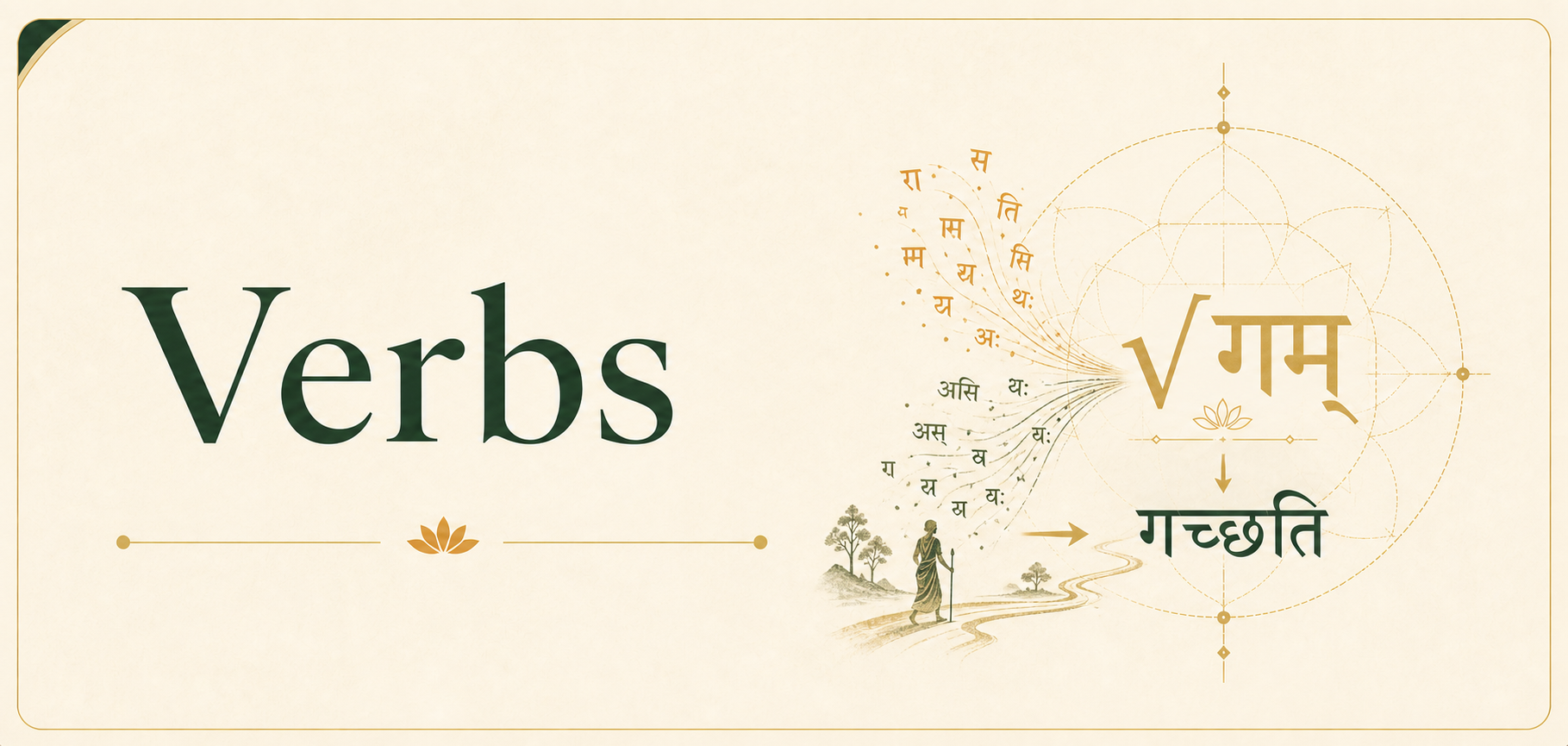
Verbs · Module 01
How the root vowel appears in the zero, guṇa and vṛddhi grades, with consonant and vowel environments shown separately.
Click any cell to see examples
V means that a vowel follows the graded element; C means that a consonant follows it. Each short and long zero-grade vowel has its own row.
| Zero grade | Guṇa (add -a-) | Vṛddhi (add -ā-) | ||
|---|---|---|---|---|
| Before V | Before C | Before V | Before C | |
| ∅ a-series | av + Vguṇa supplies a; apply the relevant vowel rule | av + C∅ + a + C → aC | āv + Vvṛddhi supplies ā; apply the relevant vowel rule | āv + C∅ + ā + C → āC |
| a + i | ayVa + i + V → ayV | eCa + i + C → eC | āyVā + i + V → āyV | aiCā + i + C → aiC |
| a + ī | ayVa + ī + V → ayV | eCa + ī + C → eC | āyVā + ī + V → āyV | aiCā + ī + C → aiC |
| a + u | avVa + u + V → avV | oCa + u + C → oC | āvVā + u + V → āvV | auCā + u + C → auC |
| a + ū | avVa + ū + V → avV | oCa + ū + C → oC | āvVā + ū + V → āvV | auCā + ū + C → auC |
| a + ṛ | arVa + ṛ + V → arV | arCa + ṛ + C → arC | ārVā + ṛ + V → ārV | ārCā + ṛ + C → ārC |
| a + ṝ | arVa + ṝ + V → arV | arCa + ṝ + C → arC | ārVā + ṝ + V → ārV | ārCā + ṝ + C → ārC |
| a + ḷ | alVa + ḷ + V → alV | alCa + ḷ + C → alC | ālVā + ḷ + V → ālV | ālCā + ḷ + C → ālC |
| a + ḹ† | alV†a + ḹ + V → alV | alC†a + ḹ + C → alC | ālV†ā + ḹ + V → ālV | ālC†ā + ḹ + C → ālC |
† Long vocalic ḹ is theoretical and does not provide a normal attested root series. The regular table lists zero-grade absence ∅ rather than a: in the a-series, guṇa supplies a and vṛddhi supplies ā.
a + i + V → ayV as a grading formula: guṇa adds a before zero-grade i, which becomes y before the following vowel. Before a consonant, the same guṇa sequence appears as e: a + i + C → eC.Vṛddhi follows the parallel pattern with ā.In this exceptional pattern, the added a or ā follows the root vowel. The root vowel therefore becomes its corresponding glide before that added vowel.
| Zero grade | Guṇa (add -a-) | Vṛddhi (add -ā-) | ||
|---|---|---|---|---|
| Before V | Before C | Before V | Before C | |
| i + a | yaVi + a + V → yaV | yaCi + a + C → yaC | yāVi + ā + V → yāV | yāCi + ā + C → yāC |
| ī + a | yaVī + a + V → yaV | yaCī + a + C → yaC | yāVī + ā + V → yāV | yāCī + ā + C → yāC |
| u + a | vaVu + a + V → vaV | vaCu + a + C → vaC | vāVu + ā + V → vāV | vāCu + ā + C → vāC |
| ū + a | vaVū + a + V → vaV | vaCū + a + C → vaC | vāVū + ā + V → vāV | vāCū + ā + C → vāC |
| ṛ + a | raVṛ + a + V → raV | raCṛ + a + C → raC | rāVṛ + ā + V → rāV | rāCṛ + ā + C → rāC |
| ṝ + a | raVṝ + a + V → raV | raCṝ + a + C → raC | rāVṝ + ā + V → rāV | rāCṝ + ā + C → rāC |
| ḷ + a | laVḷ + a + V → laV | laCḷ + a + C → laC | lāVḷ + ā + V → lāV | lāCḷ + ā + C → lāC |
| ḹ + a† | laV†ḹ + a + V → laV | laC†ḹ + a + C → laC | lāV†ḹ + ā + V → lāV | lāC†ḹ + ā + C → lāC |
ij → yaj → yāj, uc → vac → vāc, sup → svap → svāp, and ṛkṣ → rakṣ → rākṣ. These roots are conventionally cited in guṇa because the position of the inserted vowel cannot be predicted from the zero grade alone.Each row applies the general vowel-grade model to a dictionary citation form. These are transparent workings, not claims that every displayed weak or strong form is lexically attested.
These exceptional roots are cited in guṇa because the position of the inserted vowel must be learned with the root.
These roots complete the 501-root reference, but their cited forms cannot safely be derived by either simple insertion table. Learn them as lexical series and verify inflected forms in the dictionary.
Vocabulary-list examples
Verbs · Module 03
501 consolidated roots and retained verbal bases in standard Sanskrit dictionary order. Obvious duplicate citation variants and prefixed Core 1,000 occurrences are merged; six retained denominative, derived or prefixed entries are labelled as such rather than presented as independently graded roots.
Search by root, present form, grade form or English meaning.
Verbs · Root reference
What this page shows: a Sanskrit verb root can appear in several shapes when different stems and grammatical forms are built from it. Many changes follow regular, predictable processes such as vowel grade, reduplication, suffixation, and sound adjustment; others use a special stem or, rarely, replacement or suppletion. Each form here is labelled so you can see which kind of change produced it.
Complete reference
Choose any row to open that root on its own page.
Double-click the site header to return to the top.
Verbs · Irregular reference
What “irregular” means here: a verb is included when at least one important stem or construction cannot be predicted reliably from the ordinary formation rules and therefore must be learned with that verb. “Irregular” does not mean every form is random, and it does not automatically mean a different root is being used.
Verbs · Module 02
Use Overview to understand how each class builds its present stem. Open Classes for the complete active and middle paradigms.
Visual overview
The class number tells you the present-stem formation, not every form the root can make in other tense systems.
| Class | Traditional group | Grouping | Present-stem operation | Worked third singular | Evidence |
|---|---|---|---|---|---|
| 1 | भ्वादिbhvādi · Whitney bhū-class | ThematicWhitney: a-conjugation | Add -a-; apply guṇa when the root permits it.Guṇa is not possible for every root. | भू → भव- → भवतिbhū → bhava- → bhavati“is; becomes” | Whitney §606 VI§735aMW L=151456AI-assisted source-checked · no human review |
| 2 | अदादिadādi · Whitney ad-class | AthematicWhitney: non-a-conjugation | The root itself is the present stem; endings join it directly.Singular active may use a strong form; consonant junctions vary. | अद् + ति → अत्तिad + ti → atti“eats” | Whitney §603 I§§611–612MW L=3575AI-assisted source-checked · no human review |
| 3 | जुहोत्यादिjuhotyādi · Whitney hu-class | AthematicWhitney: non-a-conjugation | Prefix reduplication; strong and weak stems can differ.For √hu, the strong stem is juho- and the weak stem juhu-. | हु → जुहो-/जुहु- → जुहोतिhu → juho-/juhu- → juhoti“sacrifices; offers” | Whitney §603 II§§642–647aMW L=263443AI-assisted source-checked · no human review |
| 4 | दिवादिdivādi · Whitney div-class | ThematicWhitney: a-conjugation | Add -ya- to the accented, unstrengthened root.The div/dīv example has a specifically prescribed vowel lengthening. | दिव् → दीव्य- → दीव्यतिdiv → dīvya- → dīvyati“plays; gambles” | Whitney §606 VIII§§759–765MW L=92229AI-assisted source-checked · no human review |
| 5 | स्वादिsvādi · Whitney su-class | AthematicWhitney: non-a-conjugation | Add -nu-; its strong form is -no-.The weak -nu- changes shape before some vowel-initial endings. | सु → सुनो-/सुनु- → सुनोतिsu → suno-/sunu- → sunoti“presses out (Soma)” | Whitney §603 IVa§§697–698MW L=245241AI-assisted source-checked · no human review |
| 6 | तुदादिtudādi · Whitney tud-class | ThematicWhitney: a-conjugation | Add accented -a-; normally leave the root unstrengthened.Some class-6 stems instead show nasal strengthening (§758). | तुद् → तुद- → तुदतिtud → tuda- → tudati“thrusts; strikes” | Whitney §606 VII§§750–758MW L=85879AI-assisted source-checked · no human review |
| 7 | रुधादिrudhādi · Whitney rudh-class | AthematicWhitney: non-a-conjugation | Insert a nasal before the final consonant; strong forms expand it to -na-.The nasal adapts to the following consonant; junction rules produce ruṇaddhi. | रुध् → रुणध्-/रुन्ध्- → रुणद्धिrudh → ruṇadh-/rundh- → ruṇaddhi“obstructs” | Whitney §603 III§§683–684bMW L=178755AI-assisted source-checked · no human review |
| 8 | तनादिtanādi · Whitney tan-class | AthematicWhitney: non-a-conjugation | Add -u-; its strong form is -o-.This is a very small class; √kṛ is a common irregular member. | तन् → तनो-/तनु- → तनोतिtan → tano-/tanu- → tanoti“stretches; extends” | Whitney §603 IVb§§697–714MW L=82226AI-assisted source-checked · no human review |
| 9 | क्र्यादिkryādi · Whitney krī-class | AthematicWhitney: non-a-conjugation | Add strong -nā- or weak -nī-.The ī of weak -nī- disappears before a vowel-initial ending. | क्री → क्रीणा-/क्रीणी- → क्रीणातिkrī → krīṇā-/krīṇī- → krīṇāti“buys” | Whitney §603 V§§717–718MW L=58088AI-assisted source-checked · no human review |
| 10 | चुरादिcurādi · Whitney cur-class | ThematicWhitney: derivative a-stem | Add -aya- to a generally strengthened root.Whitney treats this as derivative/causative; strengthening has exceptions (§1042). | चुर् → चोरय- → चोरयतिcur → coraya- → corayati“steals” | Whitney §§607, 775§§1041–1043MW L=74646AI-assisted source-checked · no human review |
Structural memory pattern: Whitney groups classes 1, 4 and 6 as a-stems and classes 2, 3, 5, 7, 8 and 9 as non-a-stems. The traditionally numbered tenth class also inflects as an a-stem, but Whitney treats it as a derivative/causative formation rather than a fully parallel present class.
Classes
Choose a class and voice to jump to its table.
Verbs · System reference
These belong here in Verbs: they organize whole verbal systems. Morphology still explains how individual endings and stems are built.
Complete example
The selected finite or non-finite √gam paradigm appears here without leaving this page.
Verbs · Generated inflection
Choose a root to generate its available finite lakāras and non-finite kṛdanta forms from an indexed dhātupāṭha entry.
Verbs · Preverbs · Overview
A preverb stands before a verbal form and helps build a prefixed verbal word, redirecting or reshaping its meaning. The finished meaning is lexical: it must be checked rather than guessed by translating each piece mechanically.
Order of pieces
vyagacchan is one imperfect form, not the generic form of vi-√gam.
Structure: preverb + present stem + personal ending.
vi-√gam: vi + gaccha + ti → vigacchati
वि + गच्छ + ति → विगच्छति
vi- is the preverb, gaccha- the present stem and -ti the third-singular present ending. There is no past augment.
Structure: preverb + augment + tense stem + secondary ending.
vi-√gam: vi + a + gaccha + n → vyagacchan
वि + अ + गच्छ + न् → व्यगच्छन्
a- is the past augment and -n is the third-plural secondary ending.
Structure: preverb + causative stem + personal ending.
vi-√gam: vi + gamaya + ti → vigamayati
वि + गमय + ति → विगमयति
gamaya- is the causative stem and -ti the third-singular present ending. The causative stem is formed before the ending is added.
Structure: preverb + zero-grade root form + participial suffix.
vi-√gam: vi + gam + ta → vi + ga + ta → vigata
वि + गम् + त → वि + ग + त → विगत
This -ta participle uses the root’s weak, zero-grade form ga-, not the present stem gaccha-. Before -ta, final m is lost after a, so gam + ta → gata-. vigata can mean “gone apart” or “dispersed.”
Only the augmented example begins with a vowel collision. Before augment a-, final i of vi- becomes the glide y: vi + a → vya. In vi + gaccha-, vi + gamaya- and vi + gata-, the following sound is a consonant, so that vowel-to-glide change is not triggered.
gam is the citation root; gaccha- is its present stem, gamaya- its causative stem and gata- its participial base. Those formation-specific shapes are not competing sandhi results caused by vi-. The external ending or participial suffix belongs after the relevant stem has been selected.
Different tenses, moods, voices and non-finite formations require their own stems and endings; the preverb remains before the verbal material.
Verbs · Preverbs · List
Search all twenty-two traditional prādi forms or the exact dictionary-backed root combinations selected for this learner reference. Sort by Sanskrit preverb or by the main root; the direction button reverses either order.
| Preverb | Core direction | Main root | Representative combined meaning | Evidence |
|---|
Verbs · Overview
A Sanskrit verb form carries information about an action or state and, when finite, about its subject. Learn to distinguish the dictionary root, the stem used by a particular construction, and the ending attached to that stem.
A root is the basic verbal element listed in the reference. A stem is the form prepared for a particular set of endings. The finished word combines that stem with further grammatical material and sound changes. For example, √gam is a root, gaccha- its present stem, and gacchati means ‘goes’. Recognizing the stem is often the key to finding the root.
√गम् → गच्छ- → गच्छति√gam → gaccha- → gacchati
Go → the present stem → he, she or it goes.
Read the three levels separately: gam is the root ‘go’; gaccha- is its present stem; gacchati is a third-person singular present active form, ‘goes’. Finding -ti helps identify the finite form, but the special present stem must still be connected to its root.
The dictionary element means ‘go’; it is not itself the finite word in a sentence.
The stem used in this present construction must be learned with the root.
Third-person singular present active. Its subject is understood from context; this intransitive form has no expressed direct object.
Dictionary root √gam → special present stem gaccha- + third-singular ending -ti → gacchati.
Finite forms distinguish first, second and third person, and singular, dual and plural number. The dual refers to two. These features help connect the verb with its subject even when the subject is not placed beside it or is understood from context. Read them before settling on an English pronoun, and check agreement with any expressed subject.
बालकौ क्रीडतः।bālakau krīḍataḥ.
The two boys play.
Bālakau means ‘the two boys’ and is nominative dual. Krīḍataḥ is third-person dual present active, ‘the two play’. The matching dual forms establish a pair; translating the subject simply as plural ‘boys’ would lose information.
Masculine nominative dual of bālaka-, ‘boy’: exactly two boys.
Third-person dual present active of √krīḍ, ‘play’. The ending agrees with the dual subject.
‘Play’ is used intransitively here. Do not invent an object or reduce the dual to an unspecified plural.
Subject bālakau (two boys) → finite verb krīḍataḥ (the two play); both are dual.
The ten traditional classes organize ways of building the present stem. The class number does not supply every form in the perfect, future or other systems. Compare the stem-building recipe first, then the endings. Some stems follow a regular pattern closely; others need to be learned individually. The class chart and the root’s own record answer different parts of the same question.
भू → भव- → भवतिbhū → bhava- → bhavati
Be; become → the present stem → he, she or it is or becomes.
The class-1 chart shows the root bhū, the present stem bhava-, and bhavati, ‘is; becomes’. The stem contains the thematic a, and this root has the displayed vowel change. The class lesson warns that not every class-1 root can undergo the same guṇa operation.
The dictionary root supplies the meaning ‘be; become’.
This stem shows the root's vowel development and the thematic a; the finished form is not bhū + ti.
Third-person singular present active; its subject comes from context. No direct object is expressed in this intransitive form illustration.
Root bhū → class-1 present stem bhava- + -ti → the finite form bhavati.
Zero, guṇa and vṛddhi grades describe related vowel shapes used in word formation. They help make many changes intelligible, but a general grade table is a model, not proof of every possible form of a particular root. Check the root’s recorded constructions as well. Some apparent changes involve a special stem or another lexical feature instead of ordinary grading.
i/ī → e → ai
The i/ī vowel family has e as its guṇa grade and ai as its vṛddhi grade in the grade chart.
Read this chart sequence as zero-grade family, guṇa and vṛddhi respectively. The three items are alternative vowel grades used in formation, not three words and not an instruction to strengthen every i. For an actual root, check which construction calls for which grade before choosing a form.
The chart's starting vowel family; these are sounds, not separate words.
The corresponding guṇa result in this family.
The corresponding vṛddhi result. The arrows compare grades; they do not instruct you to perform three changes in every root.
Zero-grade family i/ī → corresponding guṇa e → corresponding vṛddhi ai; the construction selects a grade.
Tense and mood distinguish constructions used for statements, commands, possibilities and other readings. Voice and the active or middle ending sets concern a different part of the form. In a passive construction, the grammatical subject can be the participant affected by the action. Do not translate every middle form as a passive, or assign an English tense without considering the passage.
व्याधेन जालं विस्तीर्णम्vyādhena jālaṃ vistīrṇam
A net was spread by the hunter.
Jālam, ‘net’, is neuter nominative singular and agrees with the passive participle vistīrṇam. Vyādhena is instrumental, naming the agent. This passive construction is participial, not a finite middle form.
Instrumental singular of vyādha-, ‘hunter’: the person who spread it.
Neuter nominative singular, ‘net’; written jālaṃ before v. Although the shape could also be accusative in another clause, it is nominative here.
A passive participle, neuter nominative singular, ‘spread’. No finite verb or direct object is written; the net is the affected subject.
Agent vyādhena → passive event vistīrṇam ← subject/patient jālam; the participle agrees with the net.
A participle can describe a noun while retaining a verbal meaning; its case, number and gender help identify that noun. Infinitives and absolutives are indeclinable rather than personal verb forms. An absolutive commonly places one action before another. These forms should not all be translated as independent finite verbs: determine how they depend on the rest of the clause.
बालको वनं गत्वा फलानि पश्यति।bālako vanaṃ gatvā phalāni paśyati.
After going to the forest, the boy sees fruit.
Gatvā means ‘having gone’ and depends on the main verb paśyati, ‘sees’. Both actions have the boy as their understood actor: after going to the forest, he sees fruit. The absolutive does not take a separate personal ending or turn the passage into two independent finite clauses.
Masculine nominative singular, ‘the boy’; its surface -o comes from sandhi before v.
Vanam is accusative singular marking the destination ‘to the forest’. Gatvā is the absolutive of √gam, ‘having gone’.
Paśyati is third-person singular present active, ‘sees’. Phalāni is neuter accusative plural, ‘fruits’, its direct object.
One actor, the boy → first goes to the forest (gatvā + vanam) → then sees fruit (paśyati + phalāni).
A preverb can change or specialize a verb’s meaning, and its sound boundary may be altered by sandhi. Look up the combination as well as the bare root. An irregular verb may have only one construction that needs special attention; the label does not mean all its forms are unpredictable. Treat visibly unverified constructions as unresolved evidence, not as established forms.
प्र + √गम् → प्रगम्pra + √gam → pragam
Go forward; set out; advance.
Pragam is a dictionary entry combining pra- with √gam. The root contributes ‘go’, while pra helps give the recorded forward or outward sense. Learn this particular combined meaning from the entry rather than assuming one English meaning of pra fits every verb.
Adds a directional or extended sense in this recorded combination.
The underlying verbal meaning is ‘go’.
This is a prefixed root citation, not a finished finite sentence. No subject, personal ending or object is supplied.
Preverb pra + root √gam → the dictionary combination pragam with its recorded senses.
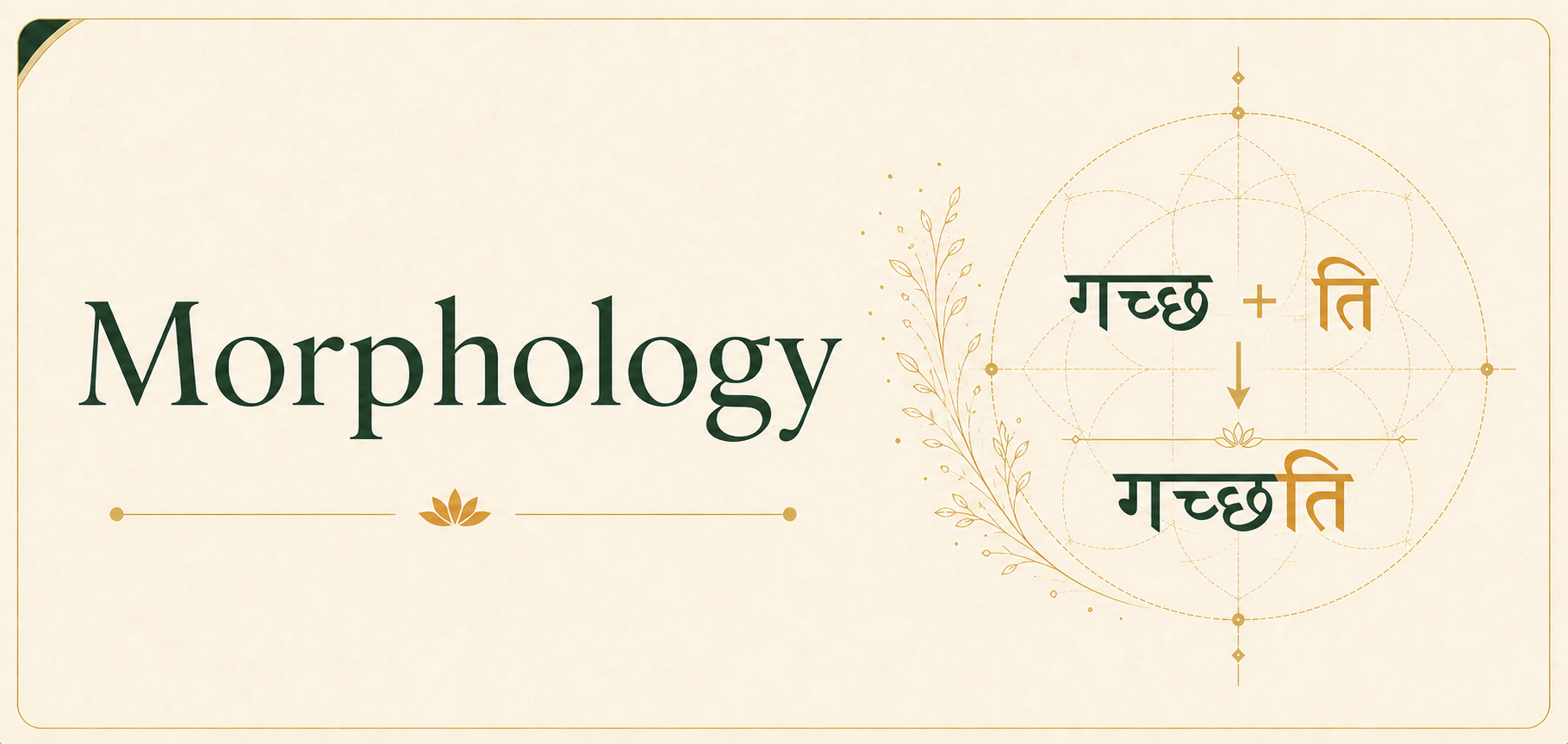
Morphology · Module 01
Enter an inflected Sanskrit form. The analyzer identifies plausible endings and shows what grammatical information each ending can carry.
The analyzer is intentionally transparent: it lists possible analyses rather than pretending that an ending always has only one meaning.
Work from the right edge. Test the longest likely ending first, since Sanskrit endings often contain several letters.
Remove the ending, then reverse predictable joining changes. A visible surface form may not reveal the dictionary stem directly.
Case, number, gender, person and voice must agree with the rest of the sentence. Context chooses among formal possibilities.
Morphology · Form Generator
Enter a dictionary stem or choose a known paradigm. The result keeps the lemma, stem, case, number and surface form visibly separate.
Nominals · Tables
Compare nouns and adjectives across stem classes, genders, cases and numbers. Stems and stem alternants are black; inflectional endings are red.
Every form cell is clickable. Open one to see its Devanāgarī and IAST forms, case, number, dictionary stem, meaning, and the displayed stem-ending split.
Quick reference
These are abstract ending patterns. The full paradigms below show how each ending joins to a real stem.
| Case | Singular | Dual | Plural | |||
|---|---|---|---|---|---|---|
| Masculine / feminine | Neuter | Masculine / feminine | Neuter | Masculine / feminine | Neuter | |
| Nominative | ः · -ḥ | — | औ · -au | ई · -ī | अः · -aḥ | इ · -i |
| Accusative | अम् · -am | — | औ · -au | ई · -ī | अः · -aḥ | इ · -i |
| Instrumental | आ · -ā | आ · -ā | भ्याम् · -bhyām | भ्याम् · -bhyām | भिः · -bhiḥ | भिः · -bhiḥ |
| Dative | ए · -e | ए · -e | भ्याम् · -bhyām | भ्याम् · -bhyām | भ्यः · -bhyaḥ | भ्यः · -bhyaḥ |
| Ablative | अः · -aḥ | अः · -aḥ | भ्याम् · -bhyām | भ्याम् · -bhyām | भ्यः · -bhyaḥ | भ्यः · -bhyaḥ |
| Genitive | अः · -aḥ | अः · -aḥ | ओः · -oḥ | ओः · -oḥ | आम् · -ām | आम् · -ām |
| Locative | इ · -i | इ · -i | ओः · -oḥ | ओः · -oḥ | सु · -su | सु · -su |
| Vocative | — | — | औ · -au | ई · -ī | अः · -aḥ | इ · -i |
Morphology · Nominals · Compound Nouns
A compound normally behaves as one stem: its internal members lose their independent sentence endings, sound changes apply at their boundary, and only the compound as a whole receives the ending required by the sentence.
Three questions
The same visible sequence can support different analyses, so test syntax and context.
How the labels fit together
These names do not all describe the same level of classification.
The final member is normally the head. This family includes case-relation compounds, karmadhāraya, dvigu, nañ, upapada and prādi formations.
The compound describes an outside referent and agrees with that referent, not necessarily with its final internal noun.
The members have equal status: A and B. Its main divisions are pair/list compounds and collective compounds.
One produces an indeclinable adverbial expression; the other repeats a form for distribution, recurrence or intensity.
Two often-missed labels: prādi-tatpuruṣa is a semantic/structural subtype of tatpuruṣa. Aluk describes a formal exception: an internal case ending is retained instead of being “deleted” (luk). An aluk compound can still be analysed as a tatpuruṣa by meaning.
Descriptive determinative
The first member describes or identifies the second: an adjective plus noun, a noun used appositionally, or a comparison. The second member is the internal and semantic head, so the whole compound has the gender and basic meaning of that member. Native classification treats karmadhāraya as the descriptive division of tatpuruṣa.
nīla- “blue” + utpala- “lotus”. The neuter head is utpala; the whole compound is neuter.
Sandhi: final a + initial u → o: nīla + utpala → nīlotpala-. Then nominative/accusative singular -m.kṛṣṇa- qualifies masculine sarpa-; the compound therefore declines as a masculine a-stem.
Sandhi: a + s remains as internally; no phonological change is required. Add nominative singular -ḥ to kṛṣṇasarpa-.नीलोत्पलं सरसि वर्धते।nīlotpalaṃ sarasi vardhate.“A blue lotus grows in the pond.”
बालकः कृष्णसर्पं पश्यति।bālakaḥ kṛṣṇasarpaṃ paśyati.“The boy sees a black snake.”
महापुरुषः सत्यं वदति।mahāpuruṣaḥ satyaṃ vadati.“A great person speaks the truth.”
Dependent determinative
The first member depends on the second as though it carried an unexpressed case ending: B of A, B for A, B by A, B from A, B in A, or motion to A. The second member remains the semantic head and determines the compound’s gender and declension.
“gone to the village”: grāmaṃ gataḥ
“handwritten”: hastena likhitam
“good for a cow / cattle”: gave hitaḥ. Whitney §1265a.
“fear of/from a thief”: corād bhayam
“the king’s son”: rājñaḥ putraḥ
“dwelling in the forest”: vane vāsaḥ
“non-dharma; wrong”: na dharmaḥ
“pot-maker”: kumbhaṃ karoti
dus-/dur- + jana-: “bad person”
the locative yudhi remains inside the compound
“blue lotus”: both members refer to the same thing
“the three worlds” viewed as a numbered set
Grammars arrange these labels differently. Karmadhāraya and dvigu may be taught as major headings or as tatpuruṣa subdivisions; aluk cuts across semantic classification because it tells you what form survives inside the compound.
राजपुत्रो नगरं गच्छति।rājaputro nagaraṃ gacchati.“The king’s son goes to the city.”
हस्तलिखितं पत्रं पठामि।hastalikhitaṃ patraṃ paṭhāmi.“I read the handwritten letter.”
रामो वनवासं स्मरति।rāmo vanavāsaṃ smarati.“Rāma remembers the forest exile.”
कुम्भकारो घटं करोति।kumbhakāro ghaṭaṃ karoti.“The potter makes a pot.”
Sandhi and endings: the hidden case-relation is semantic; its old case ending is not inserted inside the compound. Join the stems at their visible boundary, apply the appropriate internal sandhi, and inflect only the final compound stem.
Tatpuruṣa subtype · particle first
The first member belongs to the traditional pra-ādi (“pra and the rest”) inventory of particles, verbal prefixes or prefix-like bound forms, including ati-, su- and dus-/dur-. The related ku- construction is treated separately in the traditional rule ku-gati-prādayaḥ; it is not itself a member of the prādi list. In a nominal compound it determines the following noun or adjective. The final member normally remains the head and receives the compound’s external inflection.
dus-/dur- “bad, difficult” + jana- “person”. Jana- is the nominal head.
Boundary: dus- appears as dur- before voiced j. The outer nominative singular is -ḥ.su- “good” + mārga- “path”. The whole compound is instrumental singular.
Boundary: su + mārga joins unchanged; only mārga- takes -ena, yielding -eṇa by ṇatva.ati- “beyond” + mātra- “measure”. It may function adjectivally or adverbially according to context.
Boundary: i + m has no vowel-vowel sandhi; external case/number/gender is read from the final form.दुर्जनः साधुं निन्दति।durjanaḥ sādhuṃ nindati.“A bad person criticizes a good person.”
सुमार्गेण नगरं गच्छामः।sumārgeṇa nagaraṃ gacchāmaḥ.“We go to the city by a good path.”
अतिमात्रं भोजनं रोगाय भवति।atimātraṃ bhojanaṃ rogāya bhavati.“Excessive food leads to illness.”
Do not classify by spelling alone: the same first member can behave differently in a verbal derivative or in an indeclinable adverb. Here “prādi” identifies the compound relation; the sentence still tells you whether the finished compound is a noun, adjective or adverbial use.
Formal exception · case ending retained
Normally the first member enters a compound as a stem and its sentence-level case ending disappears. In an aluk formation it does not disappear: a-luk literally signals “no deletion”. The retained form is lexical and must be learned with the compound; this is not a productive instruction to preserve any convenient ending.
The dative singular ātmane “for oneself” remains before pada-.
Layers: internal ātmane + pada-; external neuter nominative/accusative singular -m is added only to pada-.The pronominal dative singular parasmai “for another” remains inside the compound.
Layers: retained -smai is internal; the whole compound still declines through final pada-.The locative singular yudhi “in battle” remains before sthira- “firm”.
Boundary: yudhi + sthira → yudhiṣṭhira- by internal retroflexion; the outer masculine nominative is -ḥ.आत्मनेपदं पठामः।ātmanepadaṃ paṭhāmaḥ.“We study the ātmanepada.”
परस्मैपदे रूपाणि भवन्ति।parasmaipade rūpāṇi bhavanti.“There are forms in the parasmaipada.”
युधिष्ठिरो धर्मं चरति।yudhiṣṭhiro dharmaṃ carati.“Yudhiṣṭhira practises dharma.”
Diagnostic: if the first member visibly contains an ending such as -e, -smai or -i that belongs to its internal case relation, test for aluk. Then parse the ending at the far right separately: that is the inflection of the whole compound.
Possessive · exocentric
The compound describes a person or thing outside itself: bahuvrīhi- literally contains “much rice” but means “one who has much rice”. Its internal final member is therefore not the external grammatical head. The whole compound functions as an adjective and agrees in gender, number, and case with the outside noun it describes.
pīta- “yellow” + ambara- “garment”. Used of a masculine person, the compound is masculine nominative singular.
Sandhi: a + a → ā: pīta + ambara → pītāmbara-. The external masculine ending gives pītāmbaraḥ.tri- + netra- denotes one who has three eyes. Because it agrees with feminine devī, the compound appears as feminine trinetrā.
Sandhi: i + n requires no vowel-vowel change; tri + netra → trinetra-. Agreement supplies feminine -ā.पीताम्बरो विष्णुः शोभते।pītāmbaro viṣṇuḥ śobhate.“Yellow-robed Viṣṇu shines.”
त्रिनेत्रा देवी पूज्यते।trinetrā devī pūjyate.“The three-eyed goddess is worshipped.”
शुद्धबुद्धिना नरेण सत्यं ज्ञायते।śuddhabuddhinā nareṇa satyaṃ jñāyate.“The truth is known by the pure-minded man.”
Coordinate · copulative
The members are coordinate: the uncompounded expression would join them with “and” (occasionally “or”). Number reflects the collection: a pair is normally dual, while three or more members are normally plural. Gender and number follow the compound’s construction rather than simply copying the last word.
Two masculine persons form a masculine dual compound.
Sandhi: rāma + lakṣmaṇa has a consonant at the boundary, so the members join unchanged; dual -au is attached once, at the end.Two neuter members form a neuter dual: the pair is treated as one compound stem.
Sandhi: sukha + duḥkha joins without a vowel-vowel change; neuter dual -e appears only at the outer edge.Each named member counts: “Rāma and Lakṣmaṇa”. A pair is dual; a longer list is plural.
The members are treated as one aggregate, conventionally neuter singular: “hands and feet collectively”.
A conventional surviving form can represent both parents. This is often taught with dvandva although no visible two-member compound remains.
रामलक्ष्मणौ वनं गच्छतः।rāmalakṣmaṇau vanaṃ gacchataḥ.“Rāma and Lakṣmaṇa go to the forest.”
मातापितरौ बालं रक्षतः।mātāpitarau bālaṃ rakṣataḥ.“Mother and father protect the child.”
फलपुष्पाणि तत्र सन्ति।phalapuṣpāṇi tatra santi.“Fruits and flowers are there.”
Repetitive · distributive
A word is repeated to express repetition, distribution, intensity, or recurrence: “day by day”, “in every house”, “again and again”. Traditional grammar names this pattern āmreḍita, but it is not an ordinary two-lemma noun compound with one member governing the other.
दिने दिनेdine dine“day by day”
गृहे गृहेgṛhe gṛhe“in every house”
पुनः पुनःpunaḥ punaḥ“again and again”
दिने दिने बालकः पठति।dine dine bālakaḥ paṭhati.“Day by day the boy studies.”
गृहे गृहे दीपा ज्वलन्ति।gṛhe gṛhe dīpā jvalanti.“Lamps burn in every house.”
पुनः पुनः स प्रश्नं पृच्छति।punaḥ punaḥ sa praśnaṃ pṛcchati.“Again and again he asks the question.”
Sandhi: repetition does not license an invented fusion. Apply the normal rule only where the two spoken forms actually meet. In punaḥ punaḥ, visarga remains before voiceless p; in dine dine and gṛhe gṛhe, final e before d/g remains visibly separate under external sandhi.
Adverbial · indeclinable
An indeclinable or particle commonly stands first, and the resulting compound is used as an indeclinable adverb—often historically the neuter accusative singular of a secondary adjective. Because the whole expression is adverbial, it does not agree with a noun in gender, case, or number.
yathā “according to” + śakti “ability”; the whole compound modifies an action.
Sandhi: final ā before ś is unchanged: yathā + śakti → yathāśakti.prati “at/every” + dina “day”. The ending belongs to the fixed adverbial compound, not agreement with a nearby noun.
Sandhi: i + d has no vowel-vowel contact: prati + dinam → pratidinam.यथाशक्ति विद्यार्थी पठति।yathāśakti vidyārthī paṭhati.“The student studies according to ability.”
प्रतिदिनं सा लिखति।pratidinaṃ sā likhati.“She writes every day.”
आजीवनं स धर्मं चरति।ājīvanaṃ sa dharmaṃ carati.“Throughout life he practises dharma.”
Morphology · Module 03
Personal pronouns and the full masculine, neuter, and feminine paradigms of tad, ayam, and asau.
“who, which” follows the tad pattern with y-. It commonly pairs with tad: “the one who …, that one …”
“who? what? which?” follows the same pattern with k-: कः kaḥ, का kā, किम् kim.
“this”: एषः eṣaḥ, एषा eṣā, एतत् etat; most oblique forms use eta-.
Morphology · Module 04
These forms bridge verbs and nominals: identify their verbal stem first, then parse their nominal ending.
Every data cell is clickable. Open one to see the formation, suffix, Devanāgarī, IAST, meaning, and agreement or indeclinability notes.
| Formation | Typical shape | Example | Core meaning |
|---|---|---|---|
| Present active | present stem + -ant | गच्छन् · gacchan (stem gacchant-) | going; one who is going |
| Present middle | present stem + -māna / -āna | लभमानः · labhamānaḥ | obtaining |
| Present passive | passive stem + -māna | क्रियमाणः · kriyamāṇaḥ | being done |
| Past passive | root + -ta / -na | कृतः · kṛtaḥ; भग्नः · bhagnaḥ | done; broken |
| Past active | past passive base + -tavat | कृतवान् · kṛtavān | one who did or has done |
| Perfect active | perfect stem + -vas | विद्वान् · vidvān (stem vidvas-) | learned; one who knows |
| Future active | future stem + -ant | करिष्यन् · kariṣyan | about to do; going to do |
| Future middle | future stem + -māna | लप्स्यमानः · lapsyamānaḥ | about to obtain |
| Gerundive | root/base + -tavya / -anīya / -ya | कर्तव्यम् · kartavyam | to be done; must be done |
| Absolutive | root + -tvā; prefixed root + -ya | कृत्वा · kṛtvā; आगत्य · āgatya | having done; after doing |
| Infinitive | root/base + -tum | कर्तुम् · kartum | to do; in order to do |
Formation · Agreement · Use
Inflecting participles are shown across masculine, feminine and neuter forms. Absolutives and infinitives are marked indeclinable.
Morphology · Overview
Morphology is the study of word forms. In Sanskrit, an ending can tell you a noun’s case and number or a verb’s person and number. Recovering those features is the bridge between recognizing a word and understanding its role in a sentence.
The form in a sentence may differ from the dictionary stem because an ending has been added and sounds have adjusted. Start by comparing the whole form with a known paradigm. Removing a few final letters is not always enough: the stem may alternate, and an ending may merge with its final sound. The full tables make those changes visible.
गजस्य → गज-gajasya → gaja-
Of the elephant → elephant, the dictionary stem.
The noun table gives gajasya as genitive singular of masculine gaja-, ‘elephant’. Read it as ‘of the elephant’ in a suitable context. The dictionary stem is gaja-, not gajasya-; the ending belongs to this particular case form. This is a paradigm illustration, not a quoted sentence.
A masculine noun meaning ‘elephant’.
Genitive singular: ‘of the elephant’. The case may express possession or another relation required by the construction.
This isolated paradigm form does not identify the possessee, a finite verb or a complete sentence.
Stem gaja- + genitive singular inflection → gajasya; recover the stem for lookup and keep the case for the sentence.
The case reference covers nominative, accusative, instrumental, dative, ablative, genitive, locative and vocative. These organize relationships such as subject, object, means, recipient, source, possession, location and address. Each case has more than one possible use. An English preposition is therefore a starting aid, not a fixed replacement for the Sanskrit ending; the local construction decides the reading.
यमेन दत्तःyamena dattaḥ
Given by Yama.
The source phrase means ‘given by Yama’. Yamena is instrumental singular and names the agent of the passive participle dattaḥ. Here the instrumental expresses ‘by’, not a physical tool: the construction determines which of the case’s possible relationships is meant.
Instrumental singular of Yama: ‘by Yama’, the giver.
Masculine nominative singular, ‘given’, from √dā. It agrees with a referent outside the quoted phrase.
No overt subject noun, finite verb or direct object is supplied. The instrumental names the agent, not the thing given.
Agent yamena → passive action dattaḥ → an understood masculine singular referent receives the description.
Nominals distinguish singular, dual and plural, and the reference records masculine, feminine and neuter patterns. Adjectives and participles agree with their noun in case, number and gender, even when other words intervene. Use this agreement to build groups. A word’s grammatical gender is part of its recorded behavior and cannot always be inferred from its meaning or final letter.
गुरुः प्रसन्नः।guruḥ prasannaḥ.
The teacher is pleased.
In ‘The teacher is pleased’, guruḥ and prasannaḥ are both masculine nominative singular. The adjective describes the teacher, so their case, number and gender agree. Present ‘is’ is understood from the sentence context rather than supplied by an overt finite verb.
Masculine nominative singular of guru-, ‘teacher’.
‘Pleased; content’, masculine nominative singular, matching the subject's case, number and gender.
No finite copula is written. This is a statement about the teacher, with no direct object.
Subject guruḥ ← agreeing predicate adjective prasannaḥ; present ‘is’ is understood.
Some case forms look alike. The dual, for example, shares forms across groups of cases, and neuter nominative and accusative forms coincide. The analyzer preserves such alternatives because the ending alone cannot settle them. Ask which interpretation fits the verb, the other words and the meaning of the clause. Ambiguity in the result is information you need to resolve.
गजौ गजाभ्याम् गजयोःgajau gajābhyām gajayoḥ
Two elephants; by, to or from two elephants; of or in two elephants, according to the case selected by context.
All three are dual forms in the gaja paradigm. Gajau serves nominative, accusative or vocative; gajābhyām serves instrumental, dative or ablative; gajayoḥ serves genitive or locative. Identifying ‘dual’ is only the first step—the sentence must settle the case.
Nominative ‘two elephants’, accusative ‘two elephants’ or vocative ‘O two elephants’.
Instrumental, dative or ablative: possible relations include ‘by’, ‘to’ or ‘from two elephants’.
Genitive ‘of two elephants’ or locative ‘in/on two elephants’. No complete sentence is given, so do not assign a unique subject or object yet.
All three groups are dual → each group permits several cases → the surrounding clause selects its role.
Pronouns have patterns that cannot safely be replaced with the endings of an ordinary noun. Participles combine a verbal formation with nominal inflection, so two questions arise: what action or state is expressed, and which noun does the form describe? Read the complete paradigm or form details before assigning an ending by analogy with a familiar noun.
ऋषिभिर् ईड्यःṛṣibhir īḍyaḥ
To be praised by sages; worthy of praise by sages.
Īḍyaḥ is a gerundive, a participial adjective expressing fitness or obligation, here masculine nominative singular. The sages are expressed by instrumental plural ṛṣibhiḥ, appearing as ṛṣibhir before the vowel. Separate the verbal meaning, agreement and sandhi.
Instrumental plural, ‘by sages’. Final visarga appears as r before the vowel ī.
Masculine nominative singular verbal adjective: ‘to be praised; worthy of praise’.
The gerundive describes a masculine singular referent outside this phrase. There is no expressed finite verb or direct object.
Agent ṛṣibhiḥ → gerundive īḍyaḥ → an understood masculine singular referent is worthy of praise.
A compound normally behaves as one stem in its sentence. First unpack the relationship between its members; then interpret the ending on the whole compound. Ask whether the final member is the head, whether the members are coordinated, or whether the expression describes someone outside the compound. Those distinctions guide the compound families and prevent a long word from becoming a mere list of meanings.
राजपुत्रः ← राज्ञः पुत्रःrājaputraḥ ← rājñaḥ putraḥ
The king's son.
The compound overview expands this as ‘the king’s son’. Internally, the king is related to the son through possession; externally, the complete compound has a nominative singular form. The final member putra supplies the head: the person referred to is a son, not a king.
The compound's first member corresponds to genitive ‘of the king’ in the expanded phrase.
‘Son’: this determines what the compound refers to. It is a son, not a king.
A genitive tatpuruṣa, masculine nominative singular. Its sentence role still needs a clause; nominative in this isolated example is not an expressed complete sentence.
Dependent member rāja- (‘of the king’) → head putra- (‘son’) → the whole compound rājaputraḥ has its own nominative singular ending.
The All Forms tool chooses the recorded inflection set for a recognized stem. If more than one recorded gender is possible, the intended gender matters; an unknown stem is reported instead of being forced into a guessed pattern. Compare the resulting form with the sentence and its case use. A matching paradigm confirms a form pattern, not the intended meaning of an entire passage.
नदी नद्याः नद्याम्nadī nadyāḥ nadyām
A river; of or from a river; in or at a river.
These are recorded forms of feminine nadī-, ‘river’: nominative singular nadī, genitive or ablative singular nadyāḥ, and locative singular nadyām. The full paradigm shows the changing stem shape and shared forms. A guessed suffix attached to an unchanged nadī would not explain all three.
‘River’: a form that can name a subject in a clause.
‘Of a river’ or ‘from a river’; the ending alone leaves these alternatives open.
‘In; at a river’. These are paradigm entries, so no one finite verb, subject or object is supplied.
Feminine stem nadī- → different case forms → the y-containing stem shape appears before these vowel-initial endings.
Analyze · Generate
Parser · Analyze & Generate
Analyze a written form without suppressing ambiguity, or request one precisely specified form. Results identify whether evidence is local, generated or returned by an external service.
Written form → supported possibilities
Accepts Devanāgarī or IAST. The local layer compares endings, exact vocabulary lemma candidates and source-held verb citation forms, then suggests matching entries from the bundled Monier–Williams dictionary. A configured hosted edition may also append an explicitly labelled Sanskrit Heritage analysis.
Enter one form. The Parser lists supportable possibilities; it does not choose a context-dependent answer for you.
Lemma/root + features → one requested form
Choose a mapped verb reading for a live Saṁsādhanī result, or a regular local a/ā-stem nominal model. A generated form is not a claim of literary attestation.
Choose exact features, then generate. Unsupported roots and empty generator responses are left blank rather than reconstructed by analogy.
व्याकरणम् · vyākaraṇam
Nominals · Cases
Read the relationship expressed in its sentence. An ending identifies a case, but context selects that case’s function.
| Case | Primary relation | How it works | Source example and working | Evidence and status |
|---|---|---|---|---|
| Nominativefirst case · prathamā | Who or what is presented as the subject?Clause roles · subject, attribute, apposition, predicate nominative | It marks the grammatical subject and words that qualify or rename that subject.Limit: grammatical subject is not the same as semantic doer; a passive patient can be nominative. | इन्द्रो ब्राह्मणो ब्रुवाणःindro brāhmaṇo bruvāṇaḥIndra, calling himself a BrahmanBoth indraḥ and predicate brāhmaṇaḥ are nominative; external sandhi gives -o before the following voiced consonants. | Whitney §267example §268aSyntax · source-attested exampleAI-assisted source-checked · no human review |
| Accusativesecond case · dvitīyā | Whom or what does the action directly reach?Argument structure · direct object, goal, extent, adverbial use | It most often marks a transitive verb’s object; it can also express a goal of motion or an extent of place, time or manner.Limit: it is not a universal English “to” case; predicate choice distinguishes it from dative uses. | अग्निम् ईडेagnim īḍeI praise Agniagnim is accusative singular, the direct object of first-person īḍe. | Whitney §269example §270Syntax · source-attested exampleAI-assisted source-checked · no human review |
| Instrumentalthird case · tṛtīyā | With whom, or by what means?Participant roles · accompaniment, means, instrument, agent | Its core “with” relation extends from accompaniment to the means, instrument or agent by which something happens.Limit: the example shows means; an instrumental is read as a passive agent only when the construction supports that role. | शस्त्रेण निधनम्śastreṇa nidhanamdeath by the swordśastreṇa is instrumental singular and supplies the means associated with nidhanam. | Whitney §278example §280Syntax · source-attested exampleAI-assisted source-checked · no human review |
| Dativefourth case · caturthī | To or for whom or what?Argument structure · indirect object, recipient, beneficiary, purpose | It points toward a recipient, beneficiary, reference or intended end; purpose is an especially common extension.Limit: not every English “to” or “for” maps to a dative, and Whitney notes that Sanskrit prepositions do not govern it. | धनुर् दर्शय रामायdhanur darśaya rāmāyaShow the bow to Ramarāmāya is dative singular, the recipient of the showing; dhanuḥ surfaces as dhanur before voiced d-. | Whitney §§285–285aexample §286blimit §288AI-assisted source-checked · no human review |
| Ablativefifth case · pañcamī | From whom or what?Semantic relations · source, separation, removal, distinction, cause | It presents a starting point: physical departure, separation, origin, or the source from which a result arises.Limit: “from” is the organizing relation, not a fixed translation; the local predicate and context determine the English wording. | लोभात् क्रोधः प्रभवतिlobhāt krodhaḥ prabhavatiAnger arises from greedlobhāt is ablative singular and identifies the source or cause from which krodhaḥ arises. | Whitney §289example §291Syntax · source-attested exampleAI-assisted source-checked · no human review |
| Genitivesixth case · ṣaṣṭhī | Whose, or related to what?Noun modification · possession, appurtenance, partitive, subjective/objective relation | It qualifies a noun by placing it in a relation that the two nouns and their context define more precisely.Limit: possession is common but not automatic; English “of” can conceal several distinct relationships. | इन्द्रस्य वज्रःindrasya vajraḥIndra’s thunderboltindrasya is genitive singular and modifies nominative vajraḥ with a possessive/appurtenant relation. | Whitney §§294a–bexample §295Syntax · source-attested exampleAI-assisted source-checked · no human review |
| Locativeseventh case · saptamī | In, on or at whom or what?Setting · spatial location, point in time, sphere, condition, circumstance | It locates something in a place, time, state or sphere; contextual extensions can overlap other case relations.Limit: its default is situation, not destination, although a “pregnant” construction can express a goal or place of rest. | पर्वतस्य पृष्ठेparvatasya pṛṣṭheon the ridge of the mountainpṛṣṭhe is locative singular; genitive parvatasya specifies the mountain whose ridge is the location. | Whitney §§301a–cexample §302alimit §304AI-assisted source-checked · no human review |
| Vocativeaddress form · saṃbodhana | Who is being addressed?Discourse function · direct address | It calls to or names the addressee rather than filling an ordinary clause role.Limit: Whitney notes that native grammarians treat it specially; apart from accent, it differs from the nominative only in the singular and not always there. | अग्नेagneO Agni!agne is the vocative singular of the masculine i-stem agni, attested at the start of Whitney’s cited verse. | Whitney §266aform §307kexample §314cAI-assisted source-checked · no human review |
The dual has three case forms: one for nominative–accusative–vocative, one for instrumental–dative–ablative, and one for genitive–locative. Context supplies the distinction.
gajau serves as nominative, accusative or vocative dual; gajābhyām as instrumental, dative or ablative dual; and gajayoḥ as genitive or locative dual.
Across the numbers, the neuter accusative is like the nominative; in the dual the shared form also serves the vocative. Vocative details still depend on stem class and accent.
These neuter singular, dual and plural forms can each be nominative or accusative. The dual phale and plural phalāni also serve as vocatives; the vocative singular is phala.
Whitney §307b · §308a · §309c
Nominals · Compounds
Expand the relation between the members, then ask whether the last member, all members together, or an external referent supplies the compound’s semantic head.
| Type | Core relation | How it works | Source example and working | Evidence and status |
|---|---|---|---|---|
| Tatpuruṣadependent determinative | What case-relation connects the first member to the final member?Nominal composition · case relation · internal head | The final member names the whole; the first is understood as its genitive, dative, instrumental, ablative, locative or accusative dependent.Limit: Whitney uses tatpuruṣa for the wider determinative class; this learner row uses the common narrower label for his dependent division. The hidden case must be read from lexical and contextual evidence. | देवसेनाdevasenāarmy of godsdeva + senā → devasenā. Project expansion: देवानां सेना devānāṃ senā; the first member has a genitive relation to the internal head senā. | Whitney §1263arule §1264example §1264aSource-attested compoundAI-assisted source-checked · no human review |
| Karmadhārayadescriptive determinative | How does the first member qualify the final member?Nominal composition · description/apposition · internal head | The final noun names the whole while the first member describes or appositionally identifies it, rather than standing in a distinct case-relation.Limit: Whitney says the descriptive/dependent boundary is not absolute, and a noun-final form can also receive a possessive Bahuvrīhi reading in context. | नीलोत्पलnīlotpalablue lotusnīla + utpala → nīlotpala. Project expansion: नीलम् उत्पलम् nīlam utpalam; “blue” directly qualifies the internal head “lotus.” | Whitney §1263arule §1279example §1279alimits §§1279c–dSource-attested compoundAI-assisted source-checked · no human review |
| Dvandvacopulative / coordinative | Are the members coordinated as if by “and”?Nominal composition · coordination · multiple-member head | Two or more members are syntactically coordinate. The ordinary form follows the final member’s declension and uses dual or plural number according to the members counted.Limit: Whitney also records alternative “or” relations and neuter singular collectives, so neither “and” nor dual inflection is universal. | विद्याकर्मणीvidyākarmaṇīknowledge and actionvidyā + karman → vidyākarmaṇī. Project expansion: विद्या च कर्म च vidyā ca karma ca; two coordinated items license the attested dual. | Whitney §§1252–1252ainflection §1253aexample §1253bcollective §§1253c–dSource-attested compoundAI-assisted source-checked · no human review |
| Bahuvrīhipossessive adjective | Who or what possesses the relation expressed inside the compound?Adjectival composition · possession · external head | A noun-final compound acquires adjectival value: the whole qualifies an external noun and adds a “having” or “possessing” relation to its internal members.Limit: the same internal members can form a non-possessive determinative; context, agreement and sometimes accent distinguish the readings. Whitney rejects “relative” as the defining label. | बृहद्रथbṛhadrathapossessing great chariotsbṛhat + ratha → bṛhadratha. Project expansion: बृहन्तो रथा यस्य bṛhanto rathā yasya; the person described, not ratha, is the external head. | Whitney §§1292a–brule §1293example §1293aname/limit §§1293c–dSource-attested compound stemAI-assisted source-checked · no human review |
| Avyayībhāvaadverbial / indeclinable use | Does an indeclinable first member make the whole function adverbially?Adverbial composition · indeclinable/particle · clause modifier | Whitney’s central type is an adverbially used accusative of a secondary adjective compound whose first member is an indeclinable or particle.Limit: other case-forms occur, and a few yathā- compounds are adjectival. “Indeclinable first member” alone therefore does not settle the compound’s use. | यथावशम्yathāvaśamas one choosesyathā + vaśam → yathāvaśam. The relative adverb sets the manner and the accusative-form whole modifies the clause adverbially. | Whitney §§1313–1313aexample §1313climits §§1313d–eSource-attested compoundAI-assisted source-checked · no human review |
| Dvigunumeral-first substantive | Does a numeral-first compound name a collective, measure or related substantive?Numeral composition · substantivization · collective/abstract value | Whitney reports the native class for substantively used numeral-first compounds, together with some related adjective compounds; number and gender follow the lexicalized use.Limit: not every numeral-first expression is Dvigu: compound cardinals and numeral possessives have separate analyses, and Whitney’s Dvigu examples vary in accent and semantic subtype. | त्रिलोकीtrilokīthe three worldstri + loka → trilokī. Project expansion: त्रयो लोकाः trayo lokāḥ; the attested feminine form names the collection as a substantive. | Whitney §§1312–1312aexample §1312bcompound numerals §1261numeral possessives §1300Source-attested later compoundAI-assisted source-checked · no human review |
These labels supplement the six principal reference rows above. They are not all competing answers to the same question: some describe the first member, some its derivation, and aluk describes the retention of an ending.
| Construction | How to recognize it | Source example | What inflects? |
|---|---|---|---|
| Prādi-tatpuruṣa | A particle/prefix determines a nominal head. Prādi is a subtype, not a seventh mutually exclusive semantic class. | अतिमात्र atimātra “exceeding measure” Whitney §1310a | ati- “beyond” + mātra- “measure”. The whole takes the ending required by its sentence; the first member does not independently decline. |
| Aluk formations | An internal case form survives instead of losing its ending. This is a formal feature that can cross semantic classifications. | युधिष्ठिर yudhiṣṭhira “firm in battle” Whitney §1250d | yudhi “in battle” + sthira- “firm”. The internal locative -i remains; an outer masculine nominative gives yudhiṣṭhiraḥ. Learn the lexical formation, not an unrestricted recipe. |
| Nañ / negative compounds | a- or an- negates the following member. A negative-looking compound can instead have a possessive interpretation, so context still matters. | अविद्या avidyā “non-knowledge; ignorance” Whitney §1288c | a- + vidyā- “knowledge”. The prefix is uninflected; the final feminine ā-stem controls ordinary nominal inflection. |
| Upapada compounds | A nominal member accompanies a verbal derivative. Its relation is part of the derivation, not merely two ordinary nouns placed together. | अन्नाद annāda “food-eating” Whitney §1265a | anna- “food” + the agent derivative -āda “eating”. Expansion: annaṃ atti, “eats food”. The compound is externally inflected, e.g. masculine nominative annādaḥ. Whitney groups this among dependent verbal compounds. |
| Āmreḍita / repetition | Repetition expresses distribution, recurrence or intensity. It is not an ordinary two-different-stem dvandva. | दिवे-दिवे dive-dive “from day to day” Whitney §1260a | The source repeats an already inflected form of div- “day”. Do not strip the first ending as though this were an ordinary noun compound. |
The listed Sanskrit forms occur in the linked Whitney sections; accents are removed and ç is normalized to ś. Explanations and expansions are teaching analyses, not verbatim source quotations. Open Compounds for the fuller worked sentences and inflection discussion.
Grammar · Foundations
Sanskrit grammar becomes manageable when four layers are kept separate: sound changes show the surface form; morphology identifies the form; syntax connects forms inside a clause; discourse explains why that wording was chosen.
Reverse only the sandhi that the written sequence supports.
Open Sandhi overviewIdentify stem or root, then ending and grammatical features.
Open the AnalyzerFind the predicate, agreement chains and case-marked roles.
Open SentencesTest emphasis, ellipsis, particles and information order.
Open ParticlesParts of speech
Classification comes before translation because the same English idea can be expressed by different Sanskrit constructions.
| Category | What changes | What it can do | Go to |
|---|---|---|---|
| Noun | case · number · usually gender | names a participant, thing, place, quality or idea | Nominal tables |
| Pronoun | case · number · gender where applicable | points, questions, relates clauses or replaces a nominal | Pronouns |
| Adjective / numeral | agrees in case, number and gender | qualifies or counts a nominal; can also be substantivized | Nominal patterns |
| Finite verb | person · number · tense/mood · voice | anchors a clause and agrees with its grammatical subject | Verbal forms |
| Participle | verbal formation plus nominal agreement | describes a participant or builds a subordinate relation | Participles |
| Indeclinable | normally no inflection | links, focuses, negates, quotes, modifies or subordinates | Particles |
A nominative form often marks the subject, but in a passive clause that subject may be the affected patient rather than the doer. Likewise, an instrumental can express an implement, accompaniment, means, cause, or passive agent.
A finite verb agrees with its subject in person and number. Adjectives and participles agree with their head noun in case, number and gender. Agreement can reveal relationships even when word order is interrupted.
Semantic roles
Roles are meanings inside an event; cases and voices are grammatical ways of presenting them.
| Role | Question | Common realization | Important caution |
|---|---|---|---|
| Agent | Who deliberately acts? | often nominative in an active clause; instrumental when expressed in a passive | the nominative is not automatically the agent |
| Patient | What is affected? | often accusative in an active clause; nominative in a passive | lexical meaning and voice determine the pattern |
| Recipient / beneficiary | To or for whom? | often dative | not every English “to” or “for” is dative |
| Instrument / means | With or by means of what? | often instrumental | distinguish an implement from a passive agent |
| Source | From where or what cause? | often ablative | the local predicate selects the exact relation |
| Location / setting | Where, when or in what sphere? | often locative | destination is normally not the default locative meaning |
Grammar · Sentences
Start with the predicate, identify its participants, connect agreeing forms, then interpret particles and word order. Sanskrit can omit material that is recoverable from grammar and context.
Repeatable method
Keep uncertain choices open until more than one clue supports them.
A finite form can anchor a clause; a participle may agree with a noun, and an absolutive or infinitive remains indeclinable.
Link the finite verb to its subject and every adjective or participle to the nominal it qualifies.
Use both the ending and the predicate: case supplies a family of relations, not one fixed English preposition.
Relative words, correlatives, conditionals, quotation marker iti and agreeing participles can show clause boundaries.
A present copula or repeated verb may be absent, but do not invent a predicate merely because two nominals are adjacent.
First preserve the grammatical relations; then produce natural English without changing agency, time, modality or emphasis.
A sentence may be a statement, question or command. Within it, clauses may be simple, coordinated, conditional, relative, or quoted content. These labels describe overlapping features: a question can also contain a relative clause. First identify the construction, then apply the same tests for predicate, agreement and case.
The first six examples below are constructed teaching sentences, not quotations from a historical text. Their forms and explanations are checked against the linked grammar. The relative and content examples are actual witnesses in Whitney; their Vedic setting and normalized display are identified.
A simple clause makes one predication: it says what a participant does, experiences or is. A finite verb carries person and number; its subject need not be stated separately.
Grammar: paṭhati is third-person singular present active. bālakaḥ is its nominative singular subject; pustakam is the neuter accusative singular object, written pustakaṃ before p. Identify the predicate first when analyzing—not because it must appear first in Sanskrit word order.
“The boy reads a book.”
Constructed teaching example. Case functions and agreement: Whitney §267, §270 and Agreement.
A nominal sentence predicates an identity, quality or state without an expressed finite verb. Sanskrit frequently leaves present “is/are” understood where context makes the relation clear.
Grammar: guruḥ and prasannaḥ are masculine nominative singular. The adjective agrees with the teacher; it does not mean that any two adjacent nominatives automatically make a sentence. The context licenses an understood present copula.
“The teacher is pleased.”
Constructed teaching example. Compare the source-attested ellipses and limits in Copula and Ellipsis, with Whitney §597.
A question may use an interrogative pronoun or adverb. A yes/no question can also be indicated by context or a question particle; an English-style reversal of subject and verb is not required.
Grammar: kutra is an indeclinable asking “where?”. Respectful bhavān means “you” but is grammatically third-person masculine singular, so it takes gacchati, not second-person gacchasi.
“Where are you going?”
Constructed teaching example. Interrogative stems: Whitney §504; bhavant: §456; pronominal adverbs: §1097.
A negative statement denies a proposition; a prohibition tells someone not to perform an action. The ordinary negative na and prohibitive mā therefore do different work.
Grammar: Here na negates third-person present gacchati. Word-final saḥ before the consonant of na appears as sa. A prohibition uses mā with a suitable verbal form; its choice depends on period and construction, and an unaugmented aorist is particularly important.
“He does not go.”
Constructed teaching example. Negative particles and prohibitive constructions: Whitney §1122c and Particles.
Coordination puts words, phrases or clauses on an equal footing: “and”, “or”, or another parallel relation. It does not make one clause a dependent part of the other.
Grammar: ca follows the second coordinated member. Rāma and Sītā together supply two participants, so āgacchataḥ is third-person dual. The word-separated form ca + āgacchataḥ becomes cāgacchataḥ by savarṇa-dīrgha.
“Rāma and Sītā come.”
Constructed teaching example. ca and vā: Whitney §1133; dual agreement: Agreement.
A conditional sentence links a condition (“if…”) to a consequence (“then…”). The condition is a subordinate clause; each clause still has its own predicate and participants.
Grammar: yadi opens the condition; optional tarhi points to the consequence. varṣati is third-person singular, used impersonally of rain. vayam takes first-person plural gacchāmaḥ. An “if” clause does not by itself require the morphological conditional tense.
“If it rains, we do not go.”
Constructed teaching example. Conditional particles and clause combination: Whitney §1131; compare Particles.
A relative clause identifies or describes someone or something (“who…”, “which…”, “what…”). Sanskrit often pairs a ya- relative with a ta- correlative in the main clause.
Grammar: In this source example, yaḥ is nominative in “who is the friend”; tasmai indrāya is dative in “sing to that Indra”. The relative and correlative refer to the same person but receive their cases independently from their own clauses. gāyata is a second-person plural imperative.
“Sing to that Indra who is the friend of the soma-presser.”
Source-attested Vedic example, with accents removed: Whitney §512a. See the full relative–correlative analysis for the source sandhi and limits.
A quotation presents words; a content clause presents what someone says, thinks, believes or perceives. iti often closes either kind of expression, so it is not simply an English quotation mark.
Grammar: iti closes santi devāḥ, “the gods exist”. santi is third-person plural, agreeing with devāḥ; śraddadhāti is third-person singular, with yaḥ as subject. Before iti, devāḥ appears as devā. The relative phrase “whoever believes…” remains dependent on its larger context.
“Whoever believes that the gods exist…”
Source-attested Vedic example, with accents removed: Whitney §1102b. Compare direct speech and fused iti in the full Quotation and Content lesson.
Grammar · Verb Forms
A verbal root identifies a lexical family. A chosen stem expresses tense-aspect, mood or derivation; a personal ending adds person, number and pada. Non-finite forms instead take participial or indeclinable suffixes.
Finite verbs
No single English tense label captures every Sanskrit use; begin with the morphology, then use context.
| Feature | Choices to identify | What it contributes |
|---|---|---|
| Person | first · second · third | speaker, addressee, or other grammatical subject |
| Number | singular · dual · plural | one, two, or more than two subjects |
| Pada / voice | parasmaipada · ātmanepada · passive morphology | ending set and the construction’s viewpoint; not a mechanical English reflexive distinction |
| System | present · perfect · aorist · future and related formations | stem choice and broad temporal/aspectual organization |
| Mood | indicative · imperative · optative · benedictive | statement, command, possibility/wish, or blessing |
These share a present-system stem but use different endings, augment or mood markers.
Open finite paradigmsPerfect stems often reduplicate and use their own endings; actual narrative value varies by period and genre.
Open verb charts“Aorist” is a family of formations, not one suffix. Identify the stem type before assigning a translation.
Compare systemsThe simple future commonly contains -iṣya-/-sya-; the periphrastic future builds a different nominal-verbal construction.
Open generated formsThe conditional combines the future stem with augment and secondary endings and is read in an appropriate conditional context.
Open finite paradigmsA distinct, comparatively restricted mood; do not infer it from an English “may” without checking the form.
Open the chart referenceVoice and viewpoint
Separate the lexical pada of a verb from the syntactic choice to present an active or passive construction.
| Pattern | Morphological signal | Typical clause alignment | Example |
|---|---|---|---|
| Active / parasmaipada | active personal endings | nominative subject; accusative object when the verb is transitive | बालकः ग्रन्थं पठतिbālakaḥ granthaṃ paṭhati · The boy reads the book. |
| Middle / ātmanepada | middle personal endings | subject remains nominative; lexical meaning determines whether English sounds reflexive, reciprocal or simply active | शिष्यः फलं लभतेśiṣyaḥ phalaṃ labhate · The student obtains the result. |
| Passive | passive stem, normally with middle endings | patient becomes nominative; an expressed agent is commonly instrumental | ग्रन्थः शिष्येण पठ्यतेgranthaḥ śiṣyeṇa paṭhyate · The book is read by the student. |
A verb’s dictionary pada and its contextual meaning must both be checked. Open Passive Viewpoint for the role change, or Verb Roots for lexical evidence.
Non-finite map
First ask whether the form declines. That single decision separates participles and gerundives from absolutives and the infinitive.
| Family | Declines? | Core task | Reference |
|---|---|---|---|
| Participles | yes | combine verbal meaning with case-number-gender agreement | All participle types |
| Gerundives | yes | express necessity, fitness or what is to be done | Gerundive tables |
| Absolutives | no | present a prior or framing action, usually sharing the main-clause subject | -tvā and -ya |
| Infinitive | no | express purpose or complement a suitable verb | -tum |
Grammar · Particles
Use these forms as signals, not one-word translation switches: position, construction and period can change the job they perform.
| Form | Core relation | How it works | Source example and working | Evidence |
|---|---|---|---|---|
| चca | and; also; bothCoordination · enclitic/postpositive particle | It follows a word or group and links it with what precedes; a repeated ca … ca can mark both members.Limit: single and repeated patterns vary by period; later prose often omits the first ca. | अहं च त्वं चahaṃ ca tvaṃ caI and youEach ca follows one coordinated pronoun; the example is cited by MW from ṚV 8.62.11. | Whitney §1133MW L=70283Attested lexical example |
| वाvā | or; eitherCoordination · disjunction · postpositive particle | It follows the alternative it marks. Repetition can make an explicit “either … or” frame.Limit: it need not appear after every member; lists and negative disjunctions use several source-recorded patterns. | वेदं वेदौ वेदान् वाvedaṃ vedau vedān vāone Veda, or two, or more than twoThe final vā follows the last alternative while the number forms supply the earlier alternatives. | Whitney §1133example §265aMW L=189435 |
| तुtu | but; howeverDiscourse relation · adversative/postpositive particle | It normally follows some opening material and sets the following thought in contrast with what is active in the discourse.Limit: older tu can be asseverative or inciting, and verse may use it as an expletive; “but” is not automatic. | नीरुजस् तु किम् औषधैःnīrujas tu kim auṣadhaiḥBut what use are medicines to a healthy person?tu follows nīrujas and marks the contrast presupposed by the rhetorical question. | Whitney §1133blimits §1122bexample §281fMW L=85706–85706.1 |
| हिhi | for; because; indeedDiscourse relation · illative or asseverative particle | It generally follows the first word and can present a reason, supporting explanation or emphatic assertion.Limit: Whitney traces the causal use to an asseverative particle and also records metrically expletive uses. | सर्वो हि पृतना जिगीषतिsarvo hi pṛtanā jigīṣatiFor everyone wishes to win battleshi follows first-position sarvaḥ; external sandhi gives displayed sarvo hi. | Whitney §1133chistory/limit §1122bMW L=262729 · exact example |
| एवeva | just; only; preciselyInformation structure · focus/emphasis particle | In later Sanskrit it strengthens the word immediately before it; English chooses “only,” “very,” “exactly,” or another contextual focus rendering.Limit: MW records uses with no exact separate translation, so “only” must not be inserted mechanically. | त्वम् एव यन्ता नान्योऽस्ति पृथिव्याम्tvam eva yantā nānyo 'sti pṛthivyāmYou alone are a charioteer; there is no other on eartheva follows tvam and gives it exclusive focus; the second clause makes that reading explicit. | Whitney §1102econtext §1122bMW L=40181.2 · exact example |
| अपिapi | also; even; moreoverAdditive/focus particle · indefinite-forming use | It can add or emphasize an item; after an interrogative form it can create an indefinite expression.Limit: “although” belongs to combinations such as yady api; it is not the fixed meaning of api alone. | अन्यद् अपि · कोऽपिanyad api · ko 'pisomething more · someone or anyoneapi adds to anyat; after interrogative kaḥ, sandhi produces the indefinite ko 'pi. | Whitney §1077aindefinites §507MW L=10132.15, 10133, 10134 |
| नna | not; no; norPolarity · simple negative particle | It negates the predicate or constituent within its scope and can be repeated across coordinated clauses.Limit: for a direct prohibition, first test mā; na has broader simple-negation work. | न ता नशन्ति न दभाति तस्करःna tā naśanti na dabhāti taskaraḥThey do not become lost; no thief harms themThe first na negates naśanti; the second separately negates dabhāti. | Whitney §1122cexample §576MW L=102621 |
| माmā | do not; let notModality/polarity · prohibitive particle | It forms a prohibition. The older regular pattern uses an augmentless past form, especially an aorist; later Sanskrit also uses an imperative.Limit: the familiar mā gaccha type is ordinary later, but Whitney does not treat it as the older default. | समाश्वसिहि मा शुचःsamāśvasihi mā śucaḥBe comforted; do not grievemā scopes over the augmentless prohibitive form śucaḥ; the preceding imperative is positive. | Whitney §§1122c–dconstruction §579example §579alater use §579cMW L=161686 |
| इतिiti | thus; quotation/citation boundaryMetalinguistic particle · speech, thought, name or reason | It follows and closes the expression being quoted, thought, named or otherwise treated as a unit.Limit: it is not an opening quotation mark and often receives no separate English word. | ब्रह्मजायेऽयम् इति चेद् अवोचन्brahmajāye 'yam iti ced avocanIf they have said, “This is a Brahman’s wife”iti follows the quoted words brahmajāye 'yam; ced avocan resumes the reporting clause. | Whitney §§1102a–bclause context §1131aMW L=28747 |
| यदा … तदाyadā … tadā | when/whenever … thenClause linkage · temporal relative–correlative pair | yadā opens the relative time frame; tadā can point back to that time in the main clause.Limit: tadā is not obligatory and is not the only possible correlative; either adverb can also occur independently. | यदा क्षयं गतं सर्वम्yadā kṣayaṃ gataṃ sarvamwhen everything had gone to ruinThis MW-cited example attests the yadā clause without an expressed tadā, illustrating the stated limitation. | Whitney §1103bconjunction context §1132MW L=170138, 82170, 82174 |
| यदि … तर्हिyadi … tarhi | if … then/in that caseClause linkage · condition and optional correlative | yadi introduces a condition; tarhi can mark the consequence as applying “then” or “in that case.”Limit: tarhi is optional, and the tense or mood in either clause depends on period and intended condition. | यदि जीवति भद्राणि पश्यतिyadi jīvati bhadrāṇi paśyatiif he lives, he sees good fortuneThe cited later-language example uses present forms in both clauses and no explicit tarhi. | Whitney §§1103d–econjunction context §1132MW L=170219, 83501 |
| यतः … ततःyataḥ … tataḥ | whence/since … thence/thereforeClause linkage · source-relative and correlative adverbs | The pair first expresses source: relative “from where/which” and correlative “from there/that.” Context can extend that relation to reason and result.Limit: “because … therefore” is a contextual causal reading, not the pair’s only or automatic meaning. | यतस् ततःyatas tataḥfrom any quarter whateverThe exact MW formula is spatial. Before t-, citation-form yataḥ surfaces as yatas. | Whitney §1098aconjunction context §1132MW L=169627/169627.4/81788.5 |
Grammar · Roles & Voice
Use agreement, case marking and verbal voice together. Use the jump buttons to move to a construction. All six explanations and their worked examples are on this page.
Syntax · Agreement
A finite verb marks person and number; an adjective or participle qualifying a noun matches that noun in gender, case and number. Those signals help connect words even when order alone does not.
Condition / limit: agreement is a constraint, not proof of a unique parse. Syncretic endings and coordinated subjects can leave more than one analysis, and an unexpressed subject can still be encoded by the verb.
Whitney §§527, 536, 541 · §§267–268aAI-assisted source-checked · no human review
Syntax · Predication and ellipsis
Sanskrit can express a predicate without an overt form of “be,” and a verb recoverable from a parallel clause can also be omitted. English supplies only the relation licensed by the local construction.
Condition / limit: adjacent nominatives do not automatically make a present-tense “X is Y” sentence. Whitney's witnesses also include non-nominative predicates and omission of a repeated past verb.
Whitney §287a · §298 · §597AI-assisted source-checked · no human review
Syntax · Passive viewpoint
A passive construction presents the affected participant as the grammatical subject. Whitney records the same instrumental-agent alignment with finite passive verbs, passive participles and gerundives.
Condition / limit: the three source witnesses below contain a passive participle or gerundive, not a finite present passive. Finite passive stems in accented -yá- are separately described at Whitney §§768–771; not every instrumental is an agent.
Whitney §282a · §§768–771 · §999AI-assisted source-checked · no human review
Syntax · Genitive absolute
In later Sanskrit, a genitive living actor with an agreeing genitive participle can stand apart from the main clause and supply a circumstance such as simultaneous seeing, hearing or speaking.
Condition / limit: Whitney calls the construction unknown in the earlier language, says its genitive actor is living, and notes a strong tendency toward verbs of seeing, hearing or uttering. A nuance of disregard can occur but is not automatic.
Whitney §300bAI-assisted source-checked · no human review
Syntax · Relative and correlative
The relative pronoun or adverb identifies an open participant or setting; a demonstrative expression in the related clause can point back to it. Each form receives the case required by its own clause.
Condition / limit: the two forms need not share a case, and the correlative can be omitted or replaced by an adverb. Whitney notes a preference—not an absolute rule—for the relative clause to come first.
Whitney §§508–510 · §512aAI-assisted source-checked · no human review
Syntax · Quotation and content marker
इति iti is an indeclinable, postpositive boundary: it can close direct words or the content of a belief, perception or label, often without a separate English equivalent.
Condition / limit: iti marks the right boundary, not necessarily the left one; sandhi may fuse it with the preceding word, and the enclosed material need not be a verbatim spoken quotation.
Whitney §§1102a–b · §1131aAI-assisted source-checked · no human review
Grammar · Searchable reference
Search 122 core terms by Sanskrit, Devanāgarī, English meaning or category. Spellings with and without diacritics both work.
Loading terminology…
Grammar · Overview
Grammar connects the forms you recognize into a meaningful statement, question, command or larger passage. Begin with the predicate and its participants, then use agreement, case, particles and context to discover how the parts belong together.
Sound changes explain the written surface. Morphology identifies roots, stems and endings. Syntax connects words within a clause, while discourse helps explain emphasis, omission and the choice of wording. These layers support one another, but one cannot replace the others. A plausible dictionary meaning does not settle the grammar, and a correct ending does not by itself produce a natural translation.
बालकः पुस्तकं पठति।bālakaḥ pustakaṃ paṭhati.
The boy reads a book.
Restore pustakam behind written pustakaṃ, identify bālakaḥ as nominative singular and pustakam as accusative singular, then connect them to paṭhati, ‘reads’. Only after those steps produce ‘The boy reads a book’; a list of three dictionary meanings would miss the relationships.
Masculine nominative singular, ‘the boy’.
Third-person singular present active of √paṭh, ‘reads’, agreeing with the singular subject.
Neuter accusative singular, ‘a book’. Final m appears as anusvāra before p; this is the thing read.
Subject bālakaḥ → finite verb paṭhati → direct object pustakam; the case endings identify the participants.
A finite verb often supplies the predicate, carrying person and number information that helps identify the subject. A clause may also make a statement with a noun or adjective while an understood form of ‘be’ is left unexpressed. Look for what is being asserted before adding an English verb. Material recoverable from context need not be explicitly repeated in Sanskrit.
अग्निर् अमुष्मिं लोक आसीद् यमोऽस्मिन्agnir amuṣmiṃ loka āsīd yamo ’smin
Agni was in yonder world; Yama was in this one.
The source contrasts ‘Agni was in yonder world; Yama in this one’. The past verb āsīt is expressed in the first half, surfacing as āsīd at its boundary. The second half does not repeat it. Recover ‘was’ from that parallel construction, rather than automatically inserting present ‘is’.
Agni is nominative; ‘in yonder world’ is the locative phrase, in the written sentence. The restored location is amuṣmin loke.
Third-person singular imperfect of √as, ‘was’. Final t voices before the next voiced sound.
Yama is the second subject; asmin means ‘in this [world]’. The omitted verb is past ‘was’, recovered from the first clause. There is no direct object in either clause.
First clause: Agni + location + ‘was’ → second clause: Yama + contrasting location + the same understood ‘was’.
A finite verb agrees with its subject in person and number. Adjectives and participles agree with their head noun in case, number and gender. Connect these groups even when words are separated. Once you know what modifies what, the sentence is easier to read without forcing Sanskrit into English word order too early or assigning each adjacent pair a relationship.
इन्द्रो ब्राह्मणो ब्रुवाणःindro brāhmaṇo bruvāṇaḥ
Indra, calling himself a Brahman; Indra pretending to be a Brahman.
This source phrase means ‘Indra, calling himself a Brahman’. The nominal forms and the participle are masculine nominative singular. Connect bruvāṇaḥ with Indra before translating the verbal idea; the preceding -o forms are surface results of sandhi, not different case endings.
Masculine nominative singular. Sandhi produces -o before the following voiced consonant.
Masculine nominative singular, ‘calling [himself]’, agreeing with Indra. It is not a separate finite verb.
‘A Brahman’ describes Indra's claimed identity. Whitney's point is that this self-description is nominative, not an accusative direct object. The phrase has no expressed finite verb.
Referent Indra ← middle participle bruvāṇaḥ → predicate nominative brāhmaṇaḥ describes what he calls himself.
Cases and voice describe how the event is presented. A nominative is often the grammatical subject, but a passive subject may be the participant affected by the action. An instrumental can supply a means or a passive agent, depending on the construction. Ask who acts, who is affected and what role each case has here instead of assigning every case one fixed English equivalent.
व्याधेन जालं विस्तीर्णम्vyādhena jālaṃ vistīrṇam
A net was spread by the hunter.
Begin with the thing affected: jālam, ‘net’, is the nominative subject and agrees with neuter vistīrṇam, ‘spread’. Instrumental vyādhena names the hunter who did it. The natural reading is ‘A net was spread by the hunter’, showing why grammatical subject and agent are not always the same participant.
Instrumental singular: ‘by the hunter’, the person doing the action.
Neuter nominative singular: ‘a net’, the thing affected. The printed jālaṃ is its surface spelling before v.
Neuter nominative singular passive participle, agreeing with jālam. No finite verb is written; no direct object is present in this passive construction.
Hunter as agent → spreading; net as grammatical subject ← agrees with passive participle ‘spread’.
A sentence may combine clauses by coordination, a condition, a relative expression or reported content. Each clause still has its own grammar. A relative and its corresponding expression need not have the same case: each gets the case required locally. An absolute construction supplies an accompanying circumstance. Work out each smaller unit before fitting the whole sentence into English.
यः सुन्वतः सखा तस्मा इन्द्राय गायतyaḥ sunvataḥ sakhā tasmā indrāya gāyata
Sing to that Indra who is the soma-presser's friend.
The Vedic sentence means ‘Sing to that Indra who is the soma-presser’s friend’. Relative yaḥ is nominative within its clause. The corresponding tasmā belongs with dative indrāya in the command. The two forms refer to the same participant but receive different cases from their own clauses.
Yaḥ is nominative singular ‘who’; sakhā is the predicate noun ‘friend’; sunvataḥ is genitive singular ‘of the soma-presser’. ‘Is’ is understood.
‘To that Indra’: the demonstrative and name refer to the relative-clause participant, but take the dative required here. Tasmā is the Vedic form used here.
Second-person plural imperative, ‘sing!’; its subject is the addressed ‘you’ plural. No direct object is expressed; Indra is the dative recipient.
Relative clause yaḥ … sakhā identifies Indra → dative tasmā indrāya names the recipient → command gāyata addresses ‘you’ plural.
Present, perfect, future and other systems differ in how their stems and endings are built. Moods can express a command, possibility, wish or blessing. Participles, infinitives and absolutives contribute verbal meaning without all behaving as independent finite verbs. Identify the construction first, then choose a translation that fits its role and the passage rather than matching one suffix to one English phrase.
दिवं जगाम मुनीनां पश्यतां तदाdivaṃ jagāma munīnāṃ paśyatāṃ tadā
He went then to heaven while the ascetics watched.
Jagāma supplies the main finite event: ‘he went’. The agreeing genitive plural pair munīnām paśyatām supplies a separate circumstance, ‘while the ascetics watched’. Translate the whole source example as ‘He went then to heaven while the ascetics watched’, not as a string of independent verbs.
Third-person singular perfect of √gam, ‘went’. The masculine ‘he’ comes from the source context; no subject noun is written in this excerpt.
Divam is accusative singular ‘to heaven’, a destination rather than a direct object; tadā is ‘then’.
‘While the ascetics watched’: genitive plural noun plus agreeing present participle, an accompanying circumstance. Neither is the main verb's subject; no direct object is expressed.
Main event: he → went → to heaven; accompanying circumstance: ascetics + watching, both genitive plural.
Particles and indeclinables can join, deny, emphasize or frame an expression without changing their form for case. Their position and scope matter. The content marker iti, for example, closes an expression that may be speech, thought or a label; it does not always need a separate English word. Use the particle reference and terminology when a short word changes the reading of the whole clause.
यः श्रद्दधाति सन्ति देवा इतिyaḥ śraddadhāti santi devā iti
Whoever believes that the gods exist.
The source example means ‘Whoever believes that the gods exist’. Iti follows and closes the believed content, santi devāḥ, ‘the gods exist’; it need not be translated as a separate English word. Find the whole enclosed statement before deciding what the surrounding verb ‘believes’ takes as its content.
‘Whoever believes’: yaḥ is nominative singular; śraddadhāti is third-person singular present active.
‘The gods exist’: devāḥ is nominative plural, subject of third-person plural santi. Before iti, devāḥ appears as devā.
Closes the statement being believed. The entire clause supplies the belief's content; there is no separate nominal direct object and no object of existential ‘exist’.
Outer subject yaḥ → believes → content clause ‘the gods exist’ → iti closes that content.
Source Reference · Vyākaraṇa
Loading the complete source-text index…
Edition · Rights · Limits
The licensed source index, proofread historical interpretation and modern project teaching notes remain distinct.
Pāṇini, Aṣṭādhyāyī as in the Kāśikā: First XML edition, edited by Peter M. Scharf, version 0.1. Providence, RI: The Sanskrit Library, 2010; based on Scharf’s 1991–1992 first digital edition.
The searchable index follows The Sanskrit Library’s complete grammatical-data edition and preserves its traditional adhyāya and pāda order.
Copyright © 2010 The Sanskrit Library. This adapted data layer is available only for noncommercial reuse with attribution and share-alike distribution. The licence does not relicense unrelated site code or original writing.
Both scripts are provided as reading aids, while source spacing and additional readings remain available with the indexed record.
The pinned Sanskrit Programmers proofreading snapshot supplies an English rule rendering and Sanskrit vṛtti for every numbered record, plus a longer Vasu commentary body for 3,982. The source project expressly permits copying and use of its corrected text.
Each record has original plain-English learner prose, technical terms, domains, conditions, source-bounded working and examples, limitations, links, sources, verification status and per-record generation provenance. This project prose is never presented as Pāṇini’s or Vasu’s wording.
The learner layer was drafted with OpenAI Codex in the GPT-5 model family and checked against the named local witnesses. It is not a modern critical edition, expert certification or complete prakriyā, and it remains bounded to 1.1.1–1.1.75.
Pāṇini · Overview
The Aṣṭādhyāyī is a reference for Sanskrit grammatical rules. Its compact statements use technical vocabulary and depend on their conditions and wider context. Read one rule with its explanation and related terms before trying to apply it to a word.
A short English rendering helps orient you, but it does not expose every technical condition of the Sanskrit rule. Identify the terms being defined or used, the form to which the rule applies, and what the rule licenses in that setting. A familiar everyday word may carry a narrower grammatical meaning here. The terminology links provide a useful bridge into that vocabulary.
आ · ऐ · औā · ai · au
The sounds ā, ai and au are designated vṛddhi.
The opening rule gives these sounds the technical name vṛddhi. Begin by identifying the members of the named set. This is a definition of a sound category, not a command to lengthen a vowel or evidence that a particular word has just undergone a change.
The sound inventory named by the opening definition.
A label for that category in this rule.
This is a technical definition, not an ordinary subject–verb–object sentence or an instruction to change every vowel.
Three named sounds ā, ai, au → the technical category vṛddhi → consult a further rule to determine when it is required.
The reference preserves the source edition’s traditional order by chapter and quarter. A numbered rule gives you a stable place to return to when comparing an explanation or a cross-reference. Search finds a starting point; reading the surrounding rules helps reveal what the result is discussing. Do not assume that a search match is a complete explanation of the grammatical form you are studying.
अ · ए · ओa · e · o
The sounds a, e and o are designated guṇa in rule 1.1.2.
Read the locator as chapter 1, quarter 1, rule 2. That exact record defines guṇa using the displayed sound inventory. Returning to the same number lets you compare the source wording and its explanation without confusing it with 1.1.1, the preceding definition of vṛddhi.
The numbers identify chapter, quarter and rule, not grammatical endings.
The sounds included in this source definition.
A named sound category; a later construction determines when a guṇa replacement is called for. There is no sentence subject or object in this inventory.
Chapter 1 → quarter 1 → rule 2 → definition of the guṇa sound category.
The opening rules include technical definitions used elsewhere in the system. A definition identifies what a label denotes; it does not automatically instruct you to perform that operation wherever the labelled sound occurs. Compare the definition with the conditions of the rule that uses it. This is especially useful when a term you know from a beginner lesson has a precise role in the source.
गुण: अ ए ओ वृद्धि: आ ऐ औguṇa: a e o vṛddhi: ā ai au
Guṇa names a, e and o; vṛddhi names ā, ai and au.
Compare the two opening definitions as labels for output sounds. Knowing that e is a guṇa vowel does not tell you when a root must acquire e. To explain a change in a real formation, you also need the rule that requires that grade in the stated environment.
The set defined at 1.1.2.
The set defined at 1.1.1.
The definitions identify categories. They do not by themselves select a replacement in a particular root or sentence.
Identify the defined sound set → identify the rule that requests it → apply that rule only in its stated environment.
When a learner note supplies a working, ask why each step is allowed. Which part of the word is being described? Which condition is satisfied? What alternatives or exceptions are stated? An example supports the point explained with it, not every possible extension of the pattern. The modern notes in the first quarter identify domains, conditions, limitations and supporting sources so that these decisions can be inspected.
नी + अति → ने + अति → नयतिnī + ati → ne + ati → nayati
He, she or it leads.
Nayati means ‘he leads’. The working first identifies the root vowel and shows its guṇa as e; the following vowel contact then gives ay, producing nayati. The learner note at 1.1.3 makes the key restriction explicit: its interpretive rule operates when a later rule calls for guṇa or vṛddhi, not at every possible vowel.
The derivation begins with √nī, ‘lead’, and the following verbal material. It is a derivation, not two words of a clause.
Guṇa gives e; the subsequent vowel contact gives ay. The two operations answer different questions.
Third-person singular present active, ‘leads’. The subject and a possible object are supplied by context; this isolated form does not name them.
Root vowel ī → guṇa e → e before the following vowel becomes ay → finite nayati.
The complete index follows the Sanskrit Library’s Kāśikā-based edition. The proofread historical layer adds an English rule rendering, Sanskrit explanation and available Vasu commentary. Modern learner notes are a separate layer limited to the opening quarter. Reading a modern explanation is useful preparation for the source, but its wording should not be mistaken for Pāṇini’s own statement or for the historical commentary.
आ · ऐ · औā · ai · au — vṛddhi
Rule 1.1.1 gives the name vṛddhi to ā, ai and au.
In this concrete record, distinguish the concise Sanskrit rule from Vasu’s historical explanation and the modern learner note. All help you understand the same defined set, but they are not one continuous quotation from Pāṇini. The displayed sound inventory is a source-supported definition example, not a newly composed Sanskrit sentence.
The sound inventory belongs to the source rule.
Read this layer as commentary on the rule, not additional words spoken by Pāṇini.
A separate explanation of the same category. This is a source-reading example rather than a sentence needing subject and object labels.
Concise Sanskrit definition → historical commentary explaining it → modern learner note illustrating its use.
After reading a rule, return to the word form or construction that prompted the question. Compare the recorded paradigm, sound environment and sentence use. The reference contains a complete numbered source index, but that does not mean every record has a full modern derivation or independent expert review. The learner notes are source-checked and explicitly marked as not yet independently reviewed by a human Sanskritist.
नी → ने → नय्- → नयतिnī → ne → nay- in nayati
The root meaning ‘lead’ appears as nay- in nayati, ‘he, she or it leads’.
Why does nayati contain ay rather than the root’s ī? The explanation needs both the chosen grade and the next sound operation. Return to the full record to inspect those steps; merely finding the word guṇa in a glossary would not explain the finished form.
The starting lexical element means ‘lead’.
Guṇa and the following vowel contact account for the visible ay; these are derivational stages, not separate sentence words.
Third-person singular present active. This form alone does not specify its subject noun or direct object; a full clause must supply that information.
Start from √nī → select the appropriate grade → explain the sound contact → identify the completed finite form.

Historical Reference · Complete Reading Edition
Whitney · Complete Scan-Backed Transcription
Wikisource Transcription
Loading the complete grammar text…
Bibliography · Digitization · Transcription · Rights
The public-domain work, scanned witness and Wikisource transcription are distinct source layers.
William Dwight Whitney, A Sanskrit Grammar: Including Both the Classical Language, and the Older Dialects, of Veda and Brahmana, second revised and extended edition, Leipzig: Breitkopf & Härtel, 1889. The scanned witness is the Harvard University Press 1950 republication, with Geoffrey Cumberlege / Oxford University Press named on its title page.
The 1950 witness was scanned for Internet Archive item 1941sanskritgram00whituoft, uploaded to Wikimedia Commons as a 584-page DjVu, and proofread through the scan-backed English Wikisource index. Book-page markers open the corresponding scan pages.
The reading edition includes all chapters, both indexes and the errata. Whole-book search returns each result to its chapter or numbered section.
Whitney’s work and the source scan are public domain. Wikisource’s transcription contributions are reused under CC BY-SA 4.0.
Whitney’s Grammar · Overview
Whitney’s Sanskrit Grammar describes both Classical Sanskrit and older language. It is most useful when you bring it a specific question about a sound, ending, stem or construction, then read the relevant section with its examples and qualifications.
A dictionary helps identify a word and its senses; a grammar explains how forms and constructions work. If you recognize the word but cannot account for its ending, combination or sentence role, a grammatical section may answer the question. Begin with the feature you are trying to understand rather than expecting a reference grammar to translate the complete passage for you.
राज + इन्द्र → राजेन्द्रrāja + indra → rājendra
Chief of kings; a king of kings.
If you recognize the two components but cannot explain the e, the relevant question is about sound combination. Whitney §127 cites this example: a and i at the boundary are replaced together by e. A dictionary search for rājendra may identify the word, but the grammar explains the relationship between the written forms.
The compound form for ‘king’, dependent on its head.
‘Chief; lord’ in this combination: the relation is ‘chief of kings’.
Whitney's sandhi example explains the e in rājendra. The displayed stem is not a full sentence with an assigned subject or object.
First compound member rāja- → head indra → boundary a + i becomes e → rājendra.
The contents move through sounds and their combinations, inflection, verbal formations, derivatives and compounds. A sound question and a formation question may need different chapters. The same visible change can involve both, so follow the cross-references when a section sends you to a particular stem or suffix. The indexes help locate a topic when its chapter is not yet familiar.
विद्याकर्मणीvidyākarmaṇī
Knowledge and action.
The compound lesson retains Whitney’s example of two coordinated members, vidyā and karman. Its dual ending belongs to the complete compound. This is a compound-structure question, so the compound discussion at §1253b is more useful than looking only for a sound change between the members.
‘Knowledge’: one member of the pair.
‘Action’: the other member. Neither member is a possessive modifier of the other.
A dual dvandva, presenting the coordinated pair. The isolated form does not settle a unique case or provide a finite clause.
Coordinated member vidyā + coordinated member karman → dvandva compound with dual inflection.
A general statement may be followed by restrictions, alternative forms or examples from a particular period. Those qualifications are part of the explanation. Do not turn an occasional or older-language form into an unrestricted modern pattern. Read the surrounding paragraph and the cited example together, especially when a shorter learner table has led you to the source for a difficult case.
गिरी आरोहतम्girī ārohatam
You two, climb the two mountains.
The dual form girī has a protected ending: final ī remains before the following ā. Do not apply ordinary glide formation merely because two different vowels meet. The grammatical identity of the dual ending is the condition you must read alongside the general vowel rule.
The second-person dual ending addresses two people.
Second-person dual imperative of ā-√ruh, ‘climb; ascend’.
‘The two mountains’, accusative dual of giri-. The final dual ī is pragṛhya and stays unchanged before the following vowel.
Addressed ‘you two’ → imperative ārohatam → accusative dual destination girī; final dual ī remains before ā.
An inflection chapter helps identify which forms belong to a paradigm; a discussion of case or construction helps explain how they are used. You may need both. For a nominal, record its case, number and gender, then ask what relationship the passage expresses. For a verb, identify its system and features before deciding how the author uses it in the sentence.
यमेन दत्तःyamena dattaḥ
Given by Yama.
A paradigm tells you that yamena is instrumental singular; the construction explains why that case identifies the giver here. Dattaḥ is a passive participle, with its masculine nominative referent supplied by context. Use the case-use discussion as well as the form table to account for the phrase.
Instrumental singular. The case marks ‘by Yama’, not a tool used in the giving.
Masculine nominative singular, agreeing with the unstated referent described as ‘given’.
The source phrase illustrates agency. A complete subject noun, finite predicate and direct object are not expressed here.
Yama as instrumental agent → passive participle ‘given’ → referent understood from the surrounding passage.
The reading edition preserves the adopted historical transcription. Its wording and spelling conventions can differ from the modern teaching pages. Search supports some familiar navigation terms, including sandhi for euphonic combination. When comparing a quotation, distinguish a normalized learner display from the original source wording. A spelling difference may reflect the display convention rather than a different grammatical analysis.
हितोपदेशःhitopadeçaḥ (historical) → hitopadeśaḥ (modern IAST)
Beneficial advice; good instruction.
Whitney §127 prints ç, corresponding to ś in modern IAST. Compare the two as different transliteration conventions for the same cited example, hita + upadeśaḥ. Do not interpret the spelling difference as an extra sound change or a different dictionary word.
‘Beneficial; good’, qualifying the instruction.
‘Instruction; advice’; the boundary a + u yields o in hitopadeśaḥ.
These spellings represent the same ś sound in the compared conventions. Changing convention does not add a new sound change or a sentence predicate.
hita (‘beneficial’) + upadeśaḥ (‘instruction’) → a + u gives o → the same word can be transcribed with historical ç or modern ś.
Book-page markers connect the transcription to scanned pages. They are useful when a character, accent, table or punctuation mark is uncertain. The complete reading edition also retains the introduction, abbreviations, indexes and errata. Treat the scan, transcription and modern lesson explanation as related aids with different purposes, and return to the source page when an exact reading matters.
अ + इत → ऐतa- + ita → aita; historical āita
Went: the source's augmented past-form illustration.
The source prints the augment example with historical āi, whereas the lesson displays the diphthong as ai. Open the section and its scan link to inspect the printed witness when that notation is unfamiliar. The normalized spelling changes the display convention, not the grammatical point about the augment.
The augment is attached grammatical material, not an independent word.
Whitney prints the ai diphthong as āi in this historical transcription.
The lesson normalizes the spelling to ai. This change of notation does not change the formation; no sentence object or expressed subject accompanies the isolated form.
Past augment a- + initial i → vṛddhi ai → normalized aita; the historical spelling āi represents the same diphthong here.
पाठशाला · pāṭhaśālā
Reading Lab · Module 01
Do not translate from left to right. First expose the morphology; then build the syntax.
Source-attested interactive line · select a word
paśyato bakamūrkhasya nakulair bhakṣitāḥ sutāḥ.
Relation-preserving: “Of the foolish heron looking on, the young were eaten by ichneumons.” Natural: “While the foolish heron looked on, its young were eaten by ichneumons.”
Sandhi §174§175apassive §282aexact witness §300bSource-attested witness · AI-assisted source-checked · no human review
Forty-three guided readings · forty-one distinct passages
Two shorter excerpts return later as complete verses. Choose a level, open a sentence, then select a word in the displayed Sanskrit line to trace it through the transliteration, translation and every relevant step.
Reading Lab · Module 02
Separate a sentence into words, inspect endings, reverse supported sandhi, and compare each form with the site’s sourced lexical and paradigm data.
Your sentence
Paste or type a sentence, or load a plain-text file. The local analyser proposes endings, table-matched nominal forms, and source-held verb forms; ambiguous results remain visibly marked.
This is a transparent local morphology aid, not a full statistical parser: sandhi and context can produce more than one valid analysis.
Your word-by-word analysis will appear here.
Reading Lab · Module 03
Generate a Sanskrit-aware reference reading for Classical, non-Vedic text, then practise the same line aloud.
Reference chant
A configured pronunciation service uses the Vāgdhenu model to generate the reference chant.
Checking the pronunciation backend…
Track vowel length, aspiration, retroflexion and mora timing. Repeat in short groups before attempting the complete line.
Vāgbodhinī/Su-śrotā supplies Sanskrit speech-recognition research tools for guided practice. Its full scoring model remains a separate service.
Open the Vāgbodhinī project ↗Vedic · Classical Sanskrit
Literature · Corpus
See which source-recorded readers are present and which collection areas remain unavailable. This page reports status only; it does not change the adopted corpus.
All ten maṇḍalas use VedaWeb’s accented University of Zurich text and morphology. The public-domain Griffith translation is supplied through VedaWeb’s stanza alignment.
Name each Upaniṣad and adopted recension separately. Record whether its source passage is prose or verse before designing its reader display.
The Bhagavad Gītā reader retains aligned Devanāgarī, IAST, translation and word analysis.
Open reader → Available nowThe Mahābhārata reader retains aligned Devanāgarī, IAST, translation and word analysis.
Open reader → Available nowAll seven kāṇḍas use DCS word analysis of the Baroda critical text. Secure Sanskrit matches add M. N. Dutt’s public-domain English translation without hiding recension differences.
This is a collection slot, not a single text. Each adopted sūtra work will receive its own source and coverage record.
This is a collection slot, not a single text. Each śāstra will be scoped and sourced independently.
This is a collection slot, not a single text. Each Purāṇa will require a named edition and an explicit coverage boundary.
Annotated corpus
Select a reader and chapter, then tap any word for its source-recorded lemma and morphology. Each stanza or verse includes an aligned English translation where the adopted source supplies one.
Loading the annotated reader…
Literature · Overview
The literature readers bring a Sanskrit passage, word analysis and an available translation together. Begin with a short unit, identify its grammar, and compare the translation after forming your own reading. Always keep the adopted text and its source information in view.
The Vedic and Classical readers are separate because their language and source conventions are not interchangeable. A form encountered in the Ṛgveda may need an older-language explanation in the grammar. The Vedic reader preserves its source’s accented Latin tokens. Its synchronized unaccented Devanāgarī helps with reading, but does not supply a second witness or recover the Vedic accent marks.
अस्मे अन्तर् निहिताः केतवः स्युःasmé antár níhitāḥ ketávaḥ syuḥ
May the rays be placed within us.
The Vedic line includes accent marks in transliteration. Those marks belong to the adopted Vedic text and should not be silently treated as ordinary modern IAST punctuation. The unaccented Devanāgarī reading aid does not recover them. Use the Vedic reader and its source information when the accent matters.
Nominative plural of ketu-, here ‘rays’. It is the subject, not an accusative object.
Níhitāḥ, ‘placed’, is masculine nominative plural; syuḥ is third-person plural optative of √as, ‘may they be’. The two agree with ketávaḥ.
‘Within us’: asmé is the protected Vedic locative plural form, followed by antár. There is no direct object. The Devanāgarī line is an unaccented reading aid, not a second accented witness.
Subject ketávaḥ → optative syuḥ + agreeing participle níhitāḥ → location asmé antár; the Latin source retains the Vedic accents.
A verse or prose unit provides relationships that a detached word cannot. First locate the predicate and any linked clauses, then inspect difficult forms. A verse boundary does not remove the need to connect participants and modifiers. The Reading Lab’s method works here too: sound division, morphology and agreement should support the reading before you polish it into English.
कर्मण्येवाधिकारस्ते मा फलेषु कदाचन।karmaṇyevādhikāraste mā phaleṣu kadācana.
Your authority is over action alone, never over its fruits.
Read this first half of Gītā 2.47 as one connected statement. The first group separates into karmaṇi + eva + adhikāraḥ + te. Its two locatives, karmaṇi and phaleṣu, delimit the sphere of authority; an understood ‘is’ links the statement. A single isolated word cannot show that contrast.
Adhikāraḥ is masculine nominative singular, ‘authority; entitlement’; te is the enclitic genitive ‘your’. They surface together as adhikāraste.
‘In action alone’: karmaṇi is locative singular of karman; eva emphasizes that sphere. The vowel boundary gives karmaṇyeva.
‘Never over the fruits’: phaleṣu is locative plural, not a direct object. No finite copula is written; the English ‘is’ expresses the understood relation.
Subject adhikāraḥ + possessor te → understood ‘is’ → sphere karmaṇi eva, contrasted with mā phaleṣu kadācana.
Selecting a word opens the source-recorded lemma and grammatical analysis, with a dictionary gloss where one is supplied. Compare that analysis with the surface form and the surrounding sentence. A gloss identifies a possible lexical sense; it is not a complete translation of the word’s function in context. Compounds and joined forms particularly benefit from checking their internal structure.
फलेषु ← फल-phaleṣu ← phala-
In, on or with regard to fruits or results; in the Gītā contrast, over the results.
In Gītā 2.47, phaleṣu is locative plural of phala-, ‘fruit; result’. The ending matters as much as the gloss: the passage contrasts the sphere of action with its fruits or results. Selecting the dictionary meaning ‘fruit’ without considering the case and context would give an incomplete reading.
Neuter noun ‘fruit; result’. Its contextual sense must be chosen from the passage.
Locative plural. It does not mean ‘fruits’ as an accusative direct object here.
The Gītā half-verse contrasts action with results as spheres of authority. This excerpt is a phrase; the clause's nominative subject is adhikāraḥ in the fuller example.
Dictionary stem phala- → locative plural phaleṣu → a sphere of concern in the larger clause.
An English translation can explain a difficult passage, but its wording may make relationships explicit that Sanskrit leaves to grammar or context. Ask what in the original supports each part of the translation. Where the site supplies a corrected project translation, its label distinguishes that work from the historical translator. Read the attribution attached to the passage rather than assuming every English line comes from one edition.
कर्मण्येवाधिकारस्ते मा फलेषु कदाचन।karmaṇyevādhikāraste mā phaleṣu kadācana.
Your authority is over action alone, never over its fruits.
Compare ‘action’ with karmaṇi, ‘alone’ with eva, and the negative expression with mā … kadācana. The English ‘is’ makes an understood relation explicit; no finite copula is written in that half-verse.
The translation combines the nominative noun and its genitive possessor.
The locative gives the sphere; eva supplies ‘alone’. This is not an object of a transitive finite verb.
Natural English makes the contrast readable. ‘Is’ and possessive ‘its’ make understood relations explicit; they are not extra Sanskrit words in this half-verse.
Sanskrit subject ‘authority’ + genitive ‘your’ → English ‘your authority’; Sanskrit locatives → English ‘over’; the absent copula → understood ‘is’.
Different editions or recensions do not always divide or transmit a passage identically. The epic readers use the adopted critical-text analyses, while translations are aligned only where the Sanskrit supports a secure match. A missing English line is not an invitation to attach a nearby translation by number alone. Use the source record to understand which text and alignment the reader is presenting.
Bhagavad Gītā 2.47; Mahābhārata uses its own book-and-subdivision locator
These are bibliographic locators: identify the work and the particular passage before comparing its wording and translation.
The readers display text-specific reference formats: the Gītā search example is 2.47, while the Mahābhārata uses a book-and-subdivision locator. Keep the work’s name with its reference, then read the Sanskrit before attaching an English passage. A matching-looking number from another work or edition is not sufficient evidence of alignment.
Keep the work name with the number; similar numbers in different readers do not identify the same text.
Each reader uses its own reference format. These are labels, not Sanskrit sentence words.
Compare actual wording before aligning passages. This reference example has no subject, predicate or object to parse.
Work title + that work's locator → adopted Sanskrit passage → securely aligned translation.
Corpus Status distinguishes available readers from collection areas that have not yet been adopted. A named collection slot is not a complete available text. For the readers that are present, source-recorded text, generated script display, grammatical annotation and translation each have their own scope. These distinctions help you decide what to trust for an exact quotation and what to use as a learning aid.
ऋग्वेद · भगवद्गीता · महाभारत · रामायणṚgveda · Bhagavad Gītā · Mahābhārata · Rāmāyaṇa
The Ṛgveda (‘Veda of verses’), the Bhagavad Gītā (‘Song of the Lord’), the Mahābhārata and the Rāmāyaṇa are the four listed available readers.
These four works are available to read. Opening one gives a particular adopted text and its accompanying analysis or translation, not a complete library of every Sanskrit work. Corpus Status helps distinguish these available readers from collection areas that do not yet supply a text.
Open the adopted Vedic text and its source conventions.
Each title opens a particular adopted reader, not every edition of that work.
The list names works; it is not a Sanskrit clause with a finite verb or an object. Check coverage separately from a reader's title.
Listed work → its adopted reader → that reader's Sanskrit, analysis and available translation.
संख्या · saṃkhyā
Search · Convert
Enter Arabic or Devanāgarī digits, English, IAST, or Harvard–Kyoto transliteration. The converter accepts values from 0 to 100,000,000.
Enter a number to see every form together.
Numbers · Module 01
Cardinals answer “how many?”; ordinals answer “which in order?” The table keeps English, Devanāgarī and IAST together.
eka is singular and declines like a pronominal adjective. dvi is dual only: masculine dvau, feminine and neuter dve. tri and catur are plural in ordinary counting and have distinct masculine, neuter and feminine forms, shown in the table.
Ordinals are adjectives agreeing with their noun in case, number and gender. Masculine and neuter forms follow the ordinary a-stem adjective patterns. prathama, dvitīya and tṛtīya form their feminine in -ā; caturtha and later ordinals ordinarily form it in -ī.
Devanāgarī has the digits ०–९, but no separate ordinal-digit signs corresponding to English 1st, 2nd or 3rd. Sanskrit normally writes the ordinal adjective; the new abbreviated-form column is therefore an English reference aid.
| Arabic digit | Devanāgarīdigit | Cardinal | Ordinal | |||||
|---|---|---|---|---|---|---|---|---|
| English | Devanāgarī | IAST | 1st, 2nd… | English | Devanāgarī | IAST | ||
Forms above twenty are built regularly but show several competing conventions in actual texts. This core table includes 0–20, the tens, one hundred and one thousand.
Source-attested reference
Bold type marks the agreeing numeral or ordinal. Translations are concise project translations, not wording attributed to the source editions.
Go to me alone for refuge.
Bhagavad Gītā 18.66 · ekaṃ agrees with masculine mām.There are two kinds of created beings in this world.
Bhagavad Gītā 16.6 · masculine dual.Having gone beyond these three qualities.
Bhagavad Gītā 14.20 · masculine accusative plural.The seven ancient seers, and likewise the four Manus.
Bhagavad Gītā 10.6 · masculine nominative plural.Karṇa, renowned by that name, was Pṛthā’s first son.
Mahābhārata 1.61.89.2 · masculine nominative singular.The second of those Asuras was Śalabha.
Mahābhārata 1.61.29.1 · masculine nominative singular.The third, O king, was a mighty-armed great Asura.
Mahābhārata 1.61.48.1 · masculine nominative singular.Another of them is named as the fourth.
Mahābhārata 1.61.49.1 · masculine nominative singular.Numbers · Overview
Sanskrit number words are part of the grammar of a sentence, not just labels for digits. Distinguish a cardinal that counts things from an ordinal that places something in order, then check how its form belongs with the noun.
A cardinal answers ‘how many?’ An ordinal answers ‘which in order?’ The reference displays these side by side so that their different jobs are visible. The English abbreviations such as 1st and 2nd are reading aids; they are not a separate set of Sanskrit numeral signs. Sanskrit normally expresses the ordinal through the appropriate adjective.
द्वौ / द्वे द्वितीय-dvau / dve dvitīya-
Two; second.
The cardinal forms answer how many: two. The ordinal stem dvitīya- answers which in order: second. The reference places them alongside one another, but they do different jobs; use the required inflection rather than substituting the word ‘second’ whenever the numerical value is 2.
‘Two’: nominative comparison forms; masculine dvau, feminine/neuter dve.
‘Second’: an adjective stem, whose case, number and gender must fit its noun.
The same numerical value does not make these interchangeable. This reference comparison supplies no sentence subject or object.
Cardinal two → counts participants; ordinal second → describes a position and takes adjectival inflection.
Arabic and Devanāgarī digits can represent the same numerical value. A spelled-out Sanskrit number is a word or expression with its own formation and, where applicable, inflection. Converting a value is useful for recognizing the counting form, but it does not automatically choose the case or gender required in a sentence. Read the numeral’s grammar as well as its value.
१० दश10 = १०; daśa
Ten.
The first two representations use different digit shapes for the same number. Daśa is the Sanskrit number word. The converter can help connect these representations, but replacing Western digits with Devanāgarī digits is not the same operation as translating or inflecting a number word.
Two digit signs represent the numerical value ten.
Different written shapes represent the same numerical value.
The number word is pronounced daśa; changing digit shapes is not the same operation as choosing or inflecting the word in a sentence.
Western digit shapes 10 ↔ Devanāgarī digit shapes १० ↔ Sanskrit number word daśa.
The reference treats the first four cardinals explicitly because their forms depend on grammatical features. One uses singular forms, two uses the dual, and three and four use plural forms in ordinary counting. Gender matters too. Compare the recorded forms and their sentence examples instead of inserting a single memorized counting form unchanged into every sentence.
द्वौ / द्वे त्रयः / त्रीणि / तिस्रःdvau / dve trayaḥ / trīṇi / tisraḥ
Two, in masculine or feminine/neuter forms; three, in masculine, neuter or feminine forms.
For two, the reference distinguishes masculine dvau from feminine and neuter dve. For three, it lists masculine trayaḥ, neuter trīṇi and feminine tisraḥ. These are reference forms for gender comparison, not every case form. Do not insert one memorized numeral unchanged into every construction.
Masculine nominative dvau; feminine/neuter nominative dve. Two ordinarily uses dual inflection.
Nominative plural: masculine, neuter and feminine respectively.
Select the form that fits the counted noun's gender and the clause's case. These entries compare forms, without a complete subject–verb–object sentence.
Numerical value + gender → the corresponding reference form; a sentence's case may require another form again.
An ordinal qualifies its noun in case, number and gender. Recognize the ordinal stem first, then identify the inflected form required by its sentence. The reference explains the feminine formations as well as the masculine and neuter patterns. A dictionary-style label such as ‘third’ is therefore only the beginning of the analysis of a particular occurrence.
पृथायाः प्रथमः सुतःpṛthāyāḥ prathamaḥ sutaḥ
Pṛthā's first son.
Mahābhārata 1.61.89.2 uses this phrase for ‘Pṛthā’s first son’. Prathamaḥ is masculine nominative singular because it qualifies sutaḥ, ‘son’. The ordinal is not just the digit 1: its form shows how ‘first’ belongs with its noun.
Genitive singular, ‘of Pṛthā’. It identifies whose son is meant.
Masculine nominative singular, ‘son’; this is the noun being described.
‘First’, masculine nominative singular, agreeing with sutaḥ. The quoted phrase has no finite verb or direct object; its role belongs to the surrounding passage.
Possessor pṛthāyāḥ → head noun sutaḥ ← agreeing ordinal prathamaḥ.
The range tables and converter help make larger numerical expressions recognizable. Actual texts can use competing conventions, especially beyond the small-number reference. When a source’s wording differs from the displayed counting form, check the complete expression before treating it as an error. The converter’s supported numerical range is a tool boundary, not a statement about every historical way of writing numbers.
शतम् सहस्रम्śatam sahasram
One hundred; one thousand.
The reference lists these as whole number words, not strings of separately pronounced digits. Use the range tables to recognize expressions built around larger values, but keep the source’s actual wording when it follows another convention. These two reference forms alone do not establish every compound or inflected numerical expression.
The reference form for ‘one hundred’, a neuter nominal form.
The reference form for ‘one thousand’, also a neuter nominal form.
These are whole words. Their isolated nominative/accusative shapes do not establish whether a particular occurrence is a subject, object or member of a larger number expression.
Recognize each whole number word → then check the complete numerical expression and its sentence context.
Find the noun or pronoun that the numeral qualifies, and compare their case, number and gender where agreement applies. Then ask whether the passage is counting, ordering or using the numeral in a particular contextual sense. The linked examples keep their source references so you can inspect the grammatical form within an actual passage rather than relying only on a conversion table.
गुणान् एतान् अतीत्य त्रीन्guṇān etān atītya trīn
Having gone beyond these three qualities.
In the Gītā 14.20 excerpt, trīn is masculine accusative plural and agrees with guṇān, ‘qualities’. The reading is ‘having gone beyond these three qualities’. The reference counting form trayaḥ would not fit this accusative construction; follow the sentence’s case rather than copying the table’s nominative form.
Absolutive of ati-√i, ‘having gone beyond’. It depends on the rest of the verse, rather than supplying a finite person ending.
Masculine accusative plural, ‘qualities’, the things transcended.
‘These three’, both masculine accusative plural, agreeing with guṇān. The nominative trayaḥ would not fit this object phrase; no subject noun is supplied in the excerpt.
Absolutive atītya → direct object guṇān ← agreeing demonstrative etān and numeral trīn; the actor comes from the full verse.
शब्दाः · śabdāḥ
Vocabulary · Module 01
Corpus rank comes from the Digital Corpus of Sanskrit frequency layer. Search in English, IAST, Devanāgarī or SLP1, then select any table heading to sort by rank, Sanskrit dictionary order, part of speech, English meaning or attestation count; select it again to reverse the order.
Reorganize this table: select any column heading to sort, then select it again—or use the arrow—to reverse the order. Part-of-speech sorting groups categories alphabetically and alphabetizes Sanskrit headwords within each category. Export downloads the current filtered and sorted rows.
Loading 1,000 corpus-ranked lemmas…
| Forms & analysis |
|---|
Analyse · Find · Generate · Convert
Search by task or name. These shortcuts open the existing tool; they do not replace its subject page.
Research · Evidence
Resources · Official Gateways
Every link below is maintained by a university, library, government body, nonprofit research organization or the resource’s official project team.
Use more than one tool: automated analyses are hypotheses, and corpus coverage varies. Confirm important readings against a named edition, dictionary entry and grammatical context.
Check headwords, senses, citations and historical lexicographic evidence.
Search digitized Sanskrit lexica, consult page scans and access documented downloadable data.
Open dictionaries ↗ University of ChicagoSearch the Sanskrit dictionaries of Apte and Macdonell within a university-maintained South Asian reference collection.
Open DSAL ↗ University of Hyderabad · external toolExplore Sanskrit synonym groups and semantic relations in the maintained Saṃsādhanī Amarakośa interface.
Open the thesaurus ↗ University of Hyderabad · external toolCompare Sanskrit synonym sets and locations across Amarakośa and other kośa traditions in the university’s maintained concordance.
Open the concordance ↗ Sanskrit Documents · external filesOpen the maintained Amarakośa text, PDF and related links at their source. Reposting restrictions mean these files are not mirrored here.
Open Amarakośa resources ↗Locate passages, compare textual collections and work with machine-readable Sanskrit.
Browse standardized machine-readable texts in Sanskrit and other Indian languages, with TEI and plain-text formats where available.
Open GRETIL ↗ Heidelberg UniversitySearch a large corpus of Sanskrit sentences with lexical and morphological annotation.
Open DCS ↗ Official SARIT ProjectBrowse and search TEI-encoded Sanskrit and Prakrit texts, with project documentation for scholarly text encoding.
Open SARIT ↗ The Sanskrit LibraryUse digitized primary texts, lexical resources and integrated research tools from a nonprofit digital library.
Open the library ↗ Sanskrit Documents · external indexBrowse sūtra text, padaccheda, rule type, terms, scope and traditional, alphabetical and Kaumudī order at the maintained source site.
Open the index ↗ Aṣṭādhyāyī.com · proofread textRead the complete rule-linked English translation and Kāśikāvṛtti-based commentary in a searchable interface, with links back to Vasu’s scans.
Open Vasu English ↗ Internet Archive · external facsimilesCheck Vasu’s 1891–1898 translation and commentary against all eight book scans. The public-domain wording is distinct from the hosted compilation’s later formatting rights.
Open the eight-book witness ↗ Internet Archive · copyrighted referenceConsult a modern translation, commentary, explanatory notes and derivational histories. Sharma remains all rights reserved, so use exact page citations and original paraphrase rather than copied prose.
Open Sharma’s commentary ↗Test segmentation, morphology, sandhi, compounds, syntax and metre.
Use the Heritage dictionary and Sanskrit Reader for segmentation, sandhi splitting, morphological tagging and parser-assisted analysis.
Open Sanskrit Heritage ↗ University of HyderabadAccess transliteration, lexicons, morphology, sandhi tools, compound analysis, parsing and specialist e-readers.
Open Saṃsādhanī ↗ The Sanskrit LibraryUse transcoders, paradigm generators, morphological analysers and a Sanskrit metre-identification tool.
Open analysis tools ↗ Sanskrit Documents · external collectionUse source-hosted dictionaries, converters, indices, metres, grammar aids and related study tools without reproducing restricted files locally.
Open learning tools ↗Extend a language question into comparative, Vedic and cultural research.
Explore Indo-European text and language materials, including Sanskrit and Vedic corpora, lexica and retrieval tools.
Open TITUS ↗ IGNCA · Ministry of Culture, IndiaConsult institutionally curated Vedic texts, recitation recordings, ritual documentation and related reference material.
Open Vedic Heritage ↗ McComas Taylor · source referenceThe site’s Sanskrit paradigm and Sandhi tables are derived from this 2009 sixth edition, produced and generously shared by McComas Taylor.
Open Taylor’s PDF ↗All 264 IAST cells in these 11 paradigms reproduce McComas Taylor, The Little Red Book of Sanskrit Paradigms, sixth edition (2009), tables/book pp.30–40 / PDF pp.41–51; all 11 pages were rendered and visually checked. The 22 two-form cells retain Taylor’s notation and explicit complete readings; 33 printed vocative dashes remain absence marks. Whitney Chapter VII provides broader pronoun context, not a replacement transcription witness.
Devanāgarī, English case/number labels, category labels and navigation are project display aids. This AI-assisted source-transcription calibration was produced by OpenAI Codex, GPT-5 model family, on 22 August 2026 under schema 2.0.0. It has not received independent full grammatical review. Taylor publicly declared the book to be in the public domain in 2013; attribution and the evidence link are retained in Resources.
Continue with structured lessons, exercises, reading environments and spoken-Sanskrit study.
Follow a free, structured introduction to Sanskrit sounds, Devanāgarī, grammar, sandhi, vocabulary and Pāṇinian concepts.
Open LearnSanskrit.org ↗ University of British ColumbiaWork through visual lessons, charts and exercises for script, phonology, sandhi, nouns, verbs, syntax and reading.
Open UBC Sanskrit ↗ Open Sanskrit libraryRead a growing collection of Sanskrit texts with accessible navigation and, where available, word-level analysis and dictionary support.
Open Ambuda ↗ University of Texas at AustinStudy an academically oriented introduction to early Sanskrit through annotated Rigvedic lessons, grammar and vocabulary.
Open Ancient Sanskrit Online ↗ Cambridge University Press & AssessmentUse the unlocked supplementary materials provided for students and instructors working with the Cambridge textbook.
Open Cambridge resources ↗ Nonprofit language organizationFind spoken-Sanskrit classes, correspondence courses, learning materials and regional programmes for children and adults.
Open Samskrita Bharati ↗Open a subject to read its editions, normalization conventions, checking records and coverage limits.
Grammar corrections, 17 October 2026: the original Taylor transcription is retained unchanged. The learner tables and analyser apply five explicit corrections: dveṣu → dveṣṭu (§617b); rudmaḥ → rundhmaḥ (§684b); rundhhām → runddhām (§689, with the weak stem and consonant treatment in §684b,c); kriṇīmahe → krīṇīmahe (§718); kriṇai → krīṇai (§722). The comparison used Heritage-derived CSL Inflect tables; the corrections follow grammar evidence, not a majority vote among tools. The valid simplified spelling rundhām must not be confused with the erroneous rundhhām. These checks do not constitute an independent full Sanskritist review.
Tools · Publication record
This page records the publication policy, attribution, licence and local changes for the principal source layers bundled into Sanskrit Study Companion.
Release record
The site and its source datasets are versioned separately. A new site release does not silently change a pinned dictionary, corpus or historical-text witness.
CC BY-NC-SA 3.0
The bundled Monier–Williams 1899 and Apte 1890 browser dictionaries use the 2014 XML editions published by The Sanskrit Library and the Cologne/University of Cologne project. The source headers record copyright © 2014 The Sanskrit Library and Thomas Malten.
Local changes: source records were reindexed and split into browser chunks; source encoding is converted for IAST and Devanāgarī display; entries are linked to local routes; and selected lexical fields, short extracts and source-grounded summaries appear in learner references. Those source-derived adaptations are distributed under CC BY-NC-SA 3.0. No source party endorses this project.
The Monier–Williams XML edition names Jim Funderburk, Thomas Malten and Peter M. Scharf as editors and credits Sharon Ben-Dor, Pawan Goyal, Malcolm D. Hyman, Susan J. Moore, Ramaswamy Chandrashekar, Wendy Teo, Sampada Savardekar Thomas and Jason Lyle Reeder for specified digital work. The Apte XML edition names Jim Funderburk, Thomas Malten and Peter M. Scharf as editors and Sampada Savardekar Thomas for correction work. The underlying printed works name Monier Monier-Williams with Ernst Leumann and Carl Cappeller, and Vaman Shivram Apte, respectively.
CC BY-NC-SA 3.0
Pāṇini, Aṣṭādhyāyī as in the Kāśikā: First XML edition, edited by Peter M. Scharf, version 0.1 (The Sanskrit Library, 2010). Data entry, XML markup and TEI template are by Peter M. Scharf; copyright © 2010 The Sanskrit Library.
Local changes: the source readings were adapted into a searchable browser index with mechanically generated IAST and Devanāgarī reading layers and local record links. This derived source-index layer remains CC BY-NC-SA 3.0. The separately sourced public-domain Vasu layer and modern project explanations retain their own stated status.
CC BY-NC-SA 4.0 · CC BY 4.0
The displayed accented text, lemmas and morphology use the University of Zurich Rigveda source in VedaWeb 1.0, licensed CC BY 4.0. The underlying 1890 Griffith translation is public domain; VedaWeb’s 2020 transcription and stanza alignment are CC BY-NC-SA 4.0.
Attribution and changes: VedaWeb 1.0 was prepared by Francisco Mondaca and Patrick Sahle. Its Zurich source identifies A. Lubotsky’s text and annotation work subsequently modified by Jakob Halfmann and Natalie Korobzow. The project converted the TEI into hymn chunks, synchronized the source tokens with mechanically generated unaccented Devanāgarī and indexed the supplied Griffith alignments. The CC BY-NC-SA alignment-derived layer remains under CC BY-NC-SA 4.0.
Other open source layers
Sanskrit Heritage morphology: © Gérard Huet 1994–2026. The selected Heritage-derived form data and grammatical tags retain the Lesser General Public License for Linguistic Resources, without warranty. On 17 October 2026, homonym identities and construction labels were separated and conflicting readings withheld. The legible adapted form records remain in root-changes-data.js; its separately identified dictionary readings retain their dictionary-source terms. Generated forms are not claims of textual attestation.
Whitney’s 1889 work and scan are public domain; the adopted Wikisource transcription and this project’s transcription adaptations remain CC BY-SA 4.0. Oliver Hellwig’s Digital Corpus of Sanskrit data are CC BY 4.0. The pinned kosha frequency release is CC BY-SA 4.0.
Local changes: the Whitney transcription was cleaned of site navigation, split into local reading chunks, linked to local routes and indexed for search. DCS data were converted into reader chunks and lemma links; kosha rows were selected and displayed with their pinned rank, count and grammatical fields. Each adapted layer keeps its named source licence.
Public domain and project layers
Public-domain texts, translations and historical explanations remain public domain. Project-authored site code, artwork and teaching prose are not placed under a blanket Creative Commons licence by this notice. Where project contributions form part of an adaptation governed by a source’s ShareAlike licence, that source-specific licence applies to the adaptation as stated above.
This notice describes the adopted release policy and source attributions; it is not legal advice or a warranty that every possible reuse is permitted.
Contact · Feedback
Contact · Message
For feedback or enquiries, please leave a message. You may include an email address if you would like a reply.
Support the project
This independent study companion is being built as a careful, source-aware resource. Voluntary support will help with source access, research time and continued development.
शब्दकोशः · Śabdakośa
Dictionary · Monier–Williams 1899
Search 193,890 digitized entry records by English definition or Sanskrit headword. Sanskrit may be entered in IAST, Devanāgarī, plain Latin or the source edition’s SLP1 spelling.
Select a result to read the complete digitized entry.
Digital data: Cologne Digital Sanskrit Dictionaries and The Sanskrit Library, CC BY-NC-SA 3.0. Edition and attribution details.
Dictionary · Apte 1890
Search 34,882 digitized entry records by English definition or Sanskrit headword. Sanskrit may be entered in IAST, Devanāgarī, plain Latin or the source edition’s SLP1 spelling.
Select a result to read the complete digitized entry.
Digital data: Cologne Digital Sanskrit Dictionaries and The Sanskrit Library, CC BY-NC-SA 3.0. Edition and attribution details.
Dictionary · Research gateways
Use these gateways to verify a dictionary form, find a text or move from a learner table into primary evidence. Availability and redistribution rights vary by collection.
Digitized Sanskrit dictionaries, scans and downloadable data. This site provides Monier–Williams and Apte readers based on the Cologne editions.
Open Cologne ↗ Sanskrit–LatinThe 1847 Sanskrit–Latin glossary in Cologne’s searchable edition, with scanned pages and downloadable digital data.
Search Bopp ↗ Greek cognate bridgeA searchable Sanskrit lexicon whose etymologies explicitly compare cognate words in Greek, Latin, Gothic and Anglo-Saxon. It is comparative evidence, not a Sanskrit–Greek translation dictionary.
Search Benfey ↗ Epic namesSørensen’s specialist index for people, places and named entities in the Mahābhārata, with Cologne search and downloads.
Search epic names ↗ Vedic names & subjectsA specialist research dictionary for Vedic names, institutions, objects and cultural subjects.
Search the Vedic Index ↗ Purāṇic namesA dedicated index to Purāṇic people, places, genealogies and narrative material; pair it with Cologne’s Purāṇic Encyclopedia.
Search the Purāṇa Index ↗ Epigraphical namesA specialist index to personal and place names in Gupta inscriptions, useful beside the Indian Epigraphical Glossary.
Search inscriptional names ↗ Epic cultureA subject index for the epic’s people, places, institutions, material culture and religious vocabulary.
Search the cultural index ↗ Specialist terminologyMeulenbeld’s reference for identifying and cross-checking Sanskrit botanical names.
Search plant names ↗ Electronic textsStandardized machine-readable Indian-language texts, including extensive Sanskrit collections and TEI/plain-text formats.
Open GRETIL ↗ Philological corpusA multilingual historical-text infrastructure with important Sanskrit and Vedic material. Some resources have restricted or collection-specific access terms.
Open TITUS ↗ Frequency & evidenceMachine-readable lemma frequencies and corpus evidence derived from the Digital Corpus of Sanskrit, used by the Core 1,000 module.
Inspect data ↗Dictionary · Overview
A dictionary connects a headword with grammatical information and recorded meanings. Use it alongside morphology and the sentence: a matching spelling or English gloss is evidence to consider, not a complete analysis of the passage.
An inflected or sandhi-altered form may need to be restored to its stem or root before it matches a headword. If a direct search fails, compare the nominal paradigm or supported parser candidates. Keep possible homonyms separate and check the grammatical label. The right spelling alone does not guarantee that you have selected the word used in your sentence.
गजस्य → गज-gajasya → gaja-
Of the elephant → elephant, the dictionary headword stem.
The noun table identifies gajasya as a genitive singular form. Restore the dictionary stem gaja- before treating a failed full-form lookup as a missing word. Keep the case meaning for the sentence: the dictionary’s basic gloss ‘elephant’ does not itself express the relation ‘of’.
Genitive singular of the masculine noun ‘elephant’.
The stem used to identify the lexical entry; its basic gloss is ‘elephant’.
A context is needed to identify what it belongs to. This isolated form has no finite verb or specified subject/object relation.
Sentence form gajasya → identify genitive singular → restore gaja- for lookup while keeping ‘of’ in the sentence reading.
Sanskrit-headword mode looks for the Sanskrit entry; English-meaning mode searches definitions. An English search can help you discover possible words, but it is not an automatic English-to-Sanskrit translation. Open the full result and compare its grammar and senses before using it. Both dictionary readers accept the scripts and transliteration formats described beside their search controls.
√गम्√gam — ‘go’
The Sanskrit root gam means ‘go’; the English search word go can retrieve more than this one entry.
The site’s √gam profile links the root with the meaning ‘go’. Searching gam as a headword asks for that Sanskrit entry; searching go in meaning mode asks which entries contain that English meaning. The latter can produce alternatives and is not permission to replace every English ‘go’ with one Sanskrit form.
The dictionary root, not a finished finite word.
A basic lexical meaning; it supplies neither person nor tense nor the rest of a sentence.
The two searches answer different questions. This root citation has no expressed sentence subject or object.
Headword search gam → one Sanskrit spelling; meaning search go → entries whose English definitions contain that meaning.
A long entry may distinguish senses, grammatical uses, derivatives or combinations. Select the meaning supported by the construction and subject matter of your passage. When a prefix or compound is involved, inspect the relevant combination as well as its parts. A plausible English word is not enough if it contradicts the Sanskrit case, verbal construction or relationship between compound members.
प्रगम्pragam
Go forward; set out; advance.
This is the exact preverb-list combination supported by Monier–Williams L=130375. Read the combined entry as well as √gam: its recorded senses are more specific than the bare root’s ‘go’. When a prefix is present in a passage, do not discard it merely because the unprefixed root is easier to find.
A meaningful part of the combination, not material to discard during lookup.
The bare root contributes ‘go’.
The entry records forward/outward senses. This prefixed-root citation has no finite person ending, subject or object of its own.
Preverb pra + root √gam → consult the combined entry → choose the sense that fits the actual construction.
The readers reproduce their adopted digitized dictionary editions. Historical wording, abbreviations and editorial conventions belong to those sources; a learner summary elsewhere on the site is a separate aid. Texts & Data links to other lexica and specialist indexes when a general entry is insufficient. Check the relevant source or scan when an exact spelling or unusual sense matters.
प्रगम्pragam — Monier–Williams L=130375
Go forward; set out; advance, as recorded for this particular prefixed-root entry.
The locator identifies the particular Monier–Williams record used by the preverb list. Its concise meaning is a teaching aid, while the dictionary reader provides the complete adopted entry and its attribution. Follow the exact record and edition when a subtle sense or spelling matters instead of treating the short gloss as the full dictionary.
The combination whose meaning is being checked.
Identifies the exact dictionary record; it is not part of the Sanskrit spelling.
These glosses orient the reader. A clause must still provide the form's subject, object if any, tense and intended sense.
Exact entry locator → adopted dictionary record → short learner gloss compared with the complete entry.
Nominal form
Selected Sandhi rule
Rights & licences
There is no single licence for the whole site. Reuse terms depend on the source layer.
ShareAlike applies only where a named source licence requires it; it does not automatically cover unrelated parts of the site.

Phone viewing
For a roomier, app-like view, add Sanskrit Study Companion to your Home Screen. It will open in its own window and remain easy to find.